Writing
- Artist: Jesús Rafael Soto
- Creation date: 1964
About
As was the case with several other artists from Venezuela, Jésus Rafael Soto moved from his home country to France in the 1950s. It was in Paris that he first encountered kinetic art, a genre that he himself would gradually become a leading exponent of. Soto worked on movement and presence in most of his works.
Like his fellow artists Alexander Calder and Jean Tinguely, Soto was interested in how movement could be represented in a work of art without seeming static. Calder and Tinguely often used mechanics or air currents to create their kinetic sculptures. Soto chose a different strategy, in that he allowed the viewer’s own movement to play a key role in how they experience his artworks.
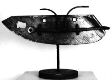
In Écriture (French for “writing”), thin threads of steel hang motionlessly in front of a background of vertical lines. But as soon as the viewer moves, even if only to shift their standing position, the illusion is created that the work is actually moving. As the the viewer interacts with the work and shifts his or her vantage point, flashes of the writing become visible. Geometric shapes seem to be swinging in front of the surface. Even as the movement makes the viewer aware of new shapes, others vanish. What is it that the viewer is actually seeing? As the viewer moves around it, Écriture resists any sort of definite reading and retains its mystery.
- Creation date:
- 1964
- Other titles:
- Skriving (NOR)
Écriture (FRE) - Object type:
- Sculpture
- Technique and material:
- bemalt tre og metall
- Material:
- Metall, Wood
- Dimensions:
- Height: 102 cm
- Depth: 16 cm
- Width: 172 cm
- Keywords:
- Visual art
- Classification:
- 532 - Bildende kunst
- Inventory no.:
- MS-02978-1988
- Cataloguing level:
- Single object
- Acquisition:
- Gave fra Nasjonalgalleriets Venner 1968
- Owner and collection:
- Nasjonalmuseet for kunst, arkitektur og design, The Fine Art Collections
- Photo:
- Nasjonalmuseet
- Copyright:
- © Soto, Jesús Rafael/BONO
Nasjonalmuseet's collection catalogue is a living resource of information gathered since the 1830's. Some records may contain language or ideas that today could be perceived as outdated, offensive or discriminatory with regard to for instance gender, sexuality, ethnicity or disability, and that may be at odds with the museum's values regarding equality and diversity.
Do you have suggestions for how this record can be improved? We would like to hear from you!
If you would like more information about specific objects in the collection or about objects that haven't been published online, please contact the museum. You can read more about how we work with the collection and our cataloguing practice here.