About
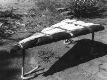
Antony Gormley’s sculptures, installations and public artworks address the relationship of the human body and its spatial environment. Learning to See IV is one of seven sculptures in his series from the early 1990s that initiated a discussion about the human figure in art and sculpture in the UK and Europe. Gormley’s idea of the body as a place of memory and transformation was tangential to issues of gender and identity politics in art at the time. The series uses the artist’s own body as subject, tool and material.
Fiberglass casts of his body were overlaid with an exterior skin of sheet lead to give them a unitary, almost mechanical appearance. The soldered lead seals of these caskets draw attention to their inner space, to what they conceal. The body that gave each sculpture its form is absent and in its place is a volume of air. The life-size sculpture is transformed into a memory container, an instrument that allows one to grasp what one cannot see. It’s about learning to see humankind’s spiritual inside. The idea came to Gormley during the casting process. While wrapped in plastered scrim, waiting for the plaster to set, he would meditate about his own body. The quiet, free-standing pose of Learning to See IV, with hands resting to side, embodies the idea of meditation. The viewer who stands and looks at it also meditates. The sculpture, viewer and absent artist share the same space and idea.
- Creation date:
- (1991)
- Object type:
- Sculpture
- Technique and material:
- bly, glassfiber, luft
- Dimensions:
- Height: 198 cm
- Depth: 28 cm
- Width: 48 cm
- Keywords:
- Visual art
- Classification:
- 532 - Bildende kunst
- Inventory no.:
- MS-03654-1994
- Cataloguing level:
- Single object
- Acquisition:
- Kjøpt 1994
- Owner and collection:
- Nasjonalmuseet for kunst, arkitektur og design, The Fine Art Collections
- Photo:
- Morten Thorkildsen
- Copyright:
- © Gormley, Antony/BONO
Nasjonalmuseet's collection catalogue is a living resource of information gathered since the 1830's. Some records may contain language or ideas that today could be perceived as outdated, offensive or discriminatory with regard to for instance gender, sexuality, ethnicity or disability, and that may be at odds with the museum's values regarding equality and diversity.
Do you have suggestions for how this record can be improved? We would like to hear from you!
If you would like more information about specific objects in the collection or about objects that haven't been published online, please contact the museum. You can read more about how we work with the collection and our cataloguing practice here.