About
Christian Boltanski is dealing with recent history in his emotially laden work. “I am half Jewish and half Christian … All my work is more or less about the Holocaust,” he said in an interview in 1994.
Boltanski transforms concrete political and personal history into universal artworks with an apparent human dimension, in the widest sense of the word. Working mainly with large scale theatrical installations he animates the viewer to engage physically with them. After this first phenomenological encounter it is difficult not to get caught up in an emotional involvement.
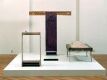
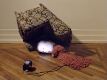
The works are often simple but fragile in execution, using universal iconography, and showing a touch of emphatic carelessness. For his Théatre d’Ombres from 1984 he uses small metal figurines, primitive in their style and handmade out of metal foil and thread. There is a skull, some ghosts, some skeletons, masks and scary faces. They are all dangling from a simple metal frame placed on the gallery floor. Light spots next to them throw their shadows multiplied in size onto the walls.
Behind the work lie children’s rituals. The dance of life and death reaches an elusive borderline here. The experience is ambivalent, at once laughable and sad. Boltanski says he has always been interested in childhood. He feels that we all carry a dead child within us.
- Creation date:
- (1984)
- Other titles:
- Théâtre d'ombres (FRE)
- Object type:
- Installation
- Technique and material:
- figurer av diverse materialer på stativ, halogenlamper og vifte
- Keywords:
- Visual art
- Classification:
- 532 - Bildende kunst
- Inventory no.:
- MS-03655-1994
- Cataloguing level:
- Complex object/artwork
- Acquisition:
- Kjøpt 1994
- Owner and collection:
- Nasjonalmuseet for kunst, arkitektur og design, The Fine Art Collections
- Photo:
- Morten Thorkildsen/Andreas Harvik
- Copyright:
- © Boltanski, Christian/BONO
Nasjonalmuseet's collection catalogue is a living resource of information gathered since the 1830's. Some records may contain language or ideas that today could be perceived as outdated, offensive or discriminatory with regard to for instance gender, sexuality, ethnicity or disability, and that may be at odds with the museum's values regarding equality and diversity.
Do you have suggestions for how this record can be improved? We would like to hear from you!
If you would like more information about specific objects in the collection or about objects that haven't been published online, please contact the museum. You can read more about how we work with the collection and our cataloguing practice here.