About
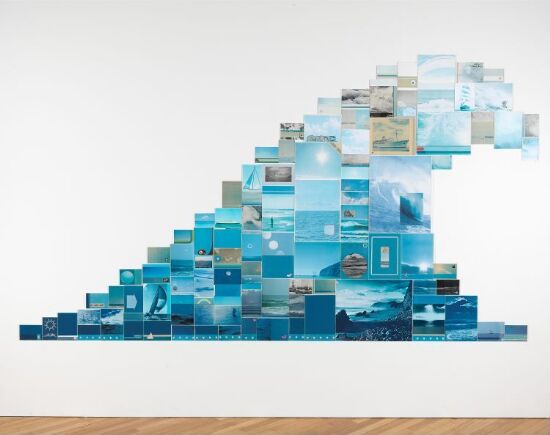
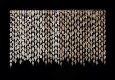
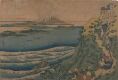
In the wall painting Surf III, Sofie Berntsen has put together various references that together form a circuit. The image is built up of contradictions where everything exists in a sort of contemporaneous time. In style and subject matter, the painted wave in the lower part of the picture is inspired by the Japanese art form ukiyo-e, literally “pictures of the Floating World”. The style originated in the Edo period (1603–1867) among artists who focused on the hedonistic aspects of life. The era’s later so famous woodcuts depicted an urban, middleclass lifestyle, where geishas, actors, sumo wrestlers, and samurais featured heavily. The woodcuts were above all used for commercial purposes and were produced in large editions. They were not regarded as high art; in fact, the artists were often seen as subversive, and censorship was not uncommon. A noteworthy aspect of ukiyo-e is that it is homonymous with the Buddhist concept of the Sorrowful World, referring to the endless cycle of life, sorrow, death, and rebirth.
Also Surf III centres on reincarnation. The wave that continually crashes against the beach, the day that turns to night, and the black and white against the various colours can all be seen as symbolizing the mutable state of existence. As with the Japanese woodcuts, there are commercial references in Berntsen’s work as well. The stars that dot the sky are based on different logotypes found by her. One such logotype stems from a Polish firm; divested of meaning and detached from its original context, it is born again here as pure form.
- Creation date:
- 2004
- Object type:
- Installation
- Materials and techniques:
- Blandet teknikk
- Dimensions:
- Height: 300 cm
- Width: 495 cm
- Keywords:
- Visual art
- Classification:
- 532 - Bildende kunst
- Inventory no.:
- NMK.2004.0391
- Cataloguing level:
- Complex object/artwork
- Acquisition:
- Kjøpt 2004
- Owner and collection:
- Nasjonalmuseet for kunst, arkitektur og design, The Fine Art Collections
- Photo:
- Børre Høstland
- Copyright:
- © Berntsen, Sofie/BONO
Nasjonalmuseet's collection catalogue is a living resource of information gathered since the 1830's. Some records may contain language or ideas that today could be perceived as outdated, offensive or discriminatory with regard to for instance gender, sexuality, ethnicity or disability, and that may be at odds with the museum's values regarding equality and diversity.
Do you have suggestions for how this record can be improved? We would like to hear from you!
If you would like more information about specific objects in the collection or about objects that haven't been published online, please contact the museum. You can read more about how we work with the collection and our cataloguing practice here.