513 Architecture Walk
City Hall Square
Narrator
Rådhusplassen, or the City Hall Square in English, is one of Oslo’s largest urban spaces!
It’s also an important gathering place for the people of Oslo. city’s population.The streets leading up from Rådhusplassen continue towards other landmarks locations such as the Castle, Karl Johan’s gate, Kvadraturen, and Akershus fortress.
Joakim Skajaa
Here, the Oslo fjord meets the city, and since the 19th century this location has been somewhere to receive dignitaries and important guests.Narrator
This is Jaokim Skajaa, curator at The National MuseumJoakim Skajaa
For example, there are several honorary piers located here. The first of which was inaugurated in 1890 when Emperor Wilhelm II of Germany visited Kristiania.And, more recently, a pier designed by the architects of the city hall, Arnstein Arneberg and Magnus Paulsson, was completed in 1940. It was here that the royal family disembarked when they returned to a recently liberated Oslo following WW2 in June of 1945.
Narrator
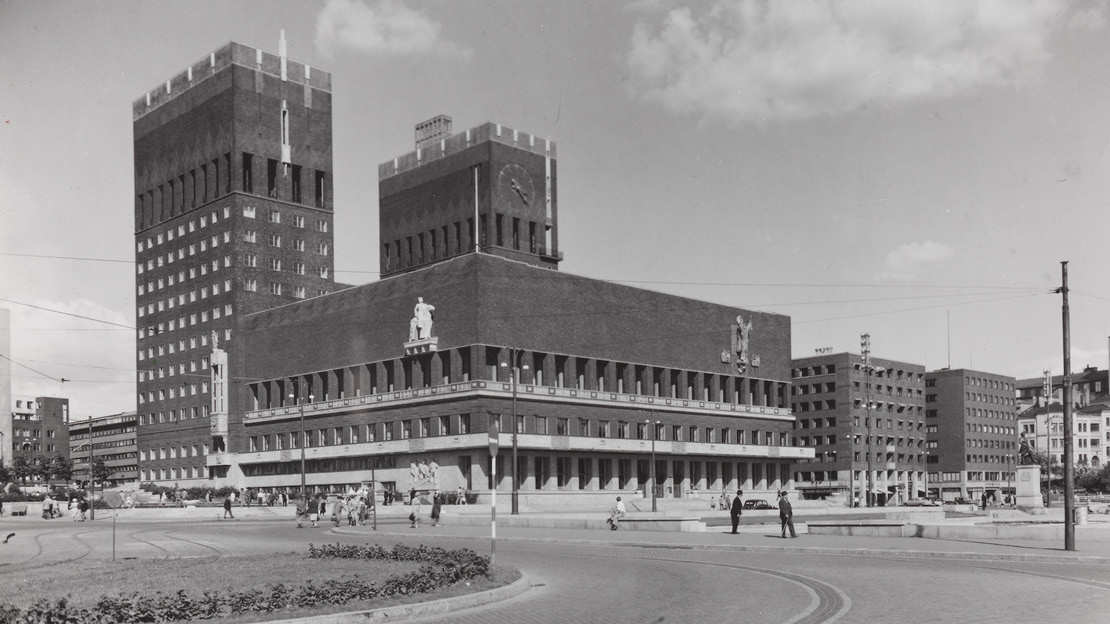
Facing the Oslo fjord is one of Oslo’s most striking buildings, the city hall itself!The architects Arneberg and Paulsson were commissioned in 1918, but construction didn’t begin until 1931!
Joakim Skajaa
However, it wasn’t completed until 1950, and by then much had changed…The architecture world had witnessed the rise of modernism, and the city had developed from 19th century Christiania to the modern city of Oslo that we know today.
The city hall reflects this shift through parallel expressions that is not easy to define...
The tall distinctive towers, with rows upon rows of identical windows, are typical of the modern and functional bureaucracy, but above them is a tower that points towards the Middle Ages and the mythical!
Narrator
Throughout the planning and construction, the town hall was a controversial project!Joakim Skajaa
Many architects were critical of the building’s design. They didn’t like its mix of styles, and perhaps even wanted something more modern. It took a long time before it was appreciated by the city’s architects.Narrator
The city hall is also known for its beautiful artistic decorations both on the interior and exterior. There are illustrations of many aspects of society from when it was built – everything from, working-class culture to high culture.Joakim Skajaa
For example, on the east side of the building, you can see the sculpture of Albertine between her pimp and a customer. This is the same Albertine who is depicted in Christian Krogh’s famous artwork in The National Museum - “Albertine to See the Police Surgeon”.It’s not a coincidence that Albertine is present at the town hall. After all, before it was built, and the surrounding area demolished in way for new buildings, this area was one of the capital’s most woeful slums – Pipervika.
This was the city’s leisure area, with a fairground – Christiania Tivoli, located between where the National Theatre and city hall are today.
Image: Arnstein Arneberg og Magnus Poulsson, Oslo Rådhus (Oslo Citty Hall), 1931–1950. Photo: E. Næss / Nasjonalmuseet