514 Architecture Walk
Skansen Restaurant
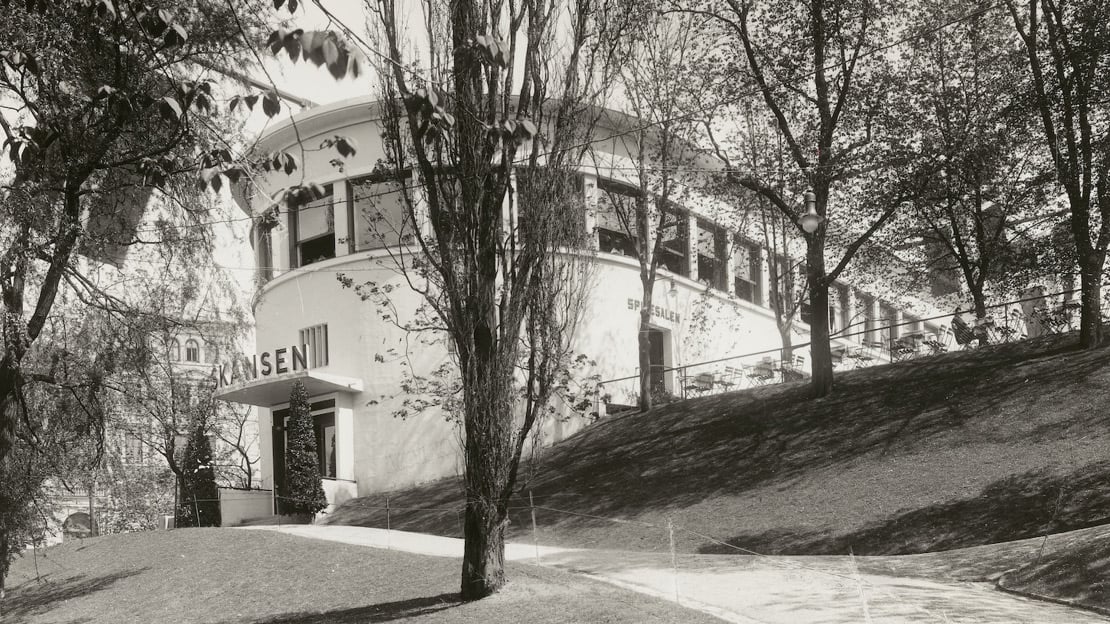
Restaurant Skansen
Narrator
It’s 1927. Imagine you’re sitting with good friends in a large, open café, enjoying good food, and perhaps even a glass of beer…Towering above you are the walls of Akershus fortress.
The harbour, with its jetties and boat traffic is in front of you…
To the west side of the harbour, there’s a hive of industrial activity coming from the Aker mechanical workshops…
The hustle and bustle of trains and people coming and going at Vestbanestasjonen joins the sea plethora of noise…
But... On the horizon... the Oslo fjord opens up...You’re in the brand new and modern Skansen restaurant which was completed in 1927. It was designed by architect Lars Backer for Oslo municipality and run by Schous brewery.
Birgitte Sauge
Skansen was one of the earliest examples of functionalist architecture in Scandinavia!Narrator
This is Birgitte Sauge, curator at The National MuseumBirgitte Sauge
In addition to the large restaurant, there was a terrace surrounding the building for outdoor dining.Here, the good life extended into the bright long summer evenings…
Narrator
Behind Skansen restaurant, the new functionalist “funkis city” was rising. The older, low wooden buildings in Pipervika and newer office buildings along Sjøgaten, in the so-called bricks and mortar city, had been demolished to make room for the new city hall.Birgitte Sauge
Unfortunately, the Skansen restaurant was demolished in 1970 to create a park in front of the fortress walls.However, in a series of continued development in the area over the next two-three decades, the evolution of how Rådhusgata - or city hall street in English - became what we know it as today...
The construction of an underground railway tunnel resulted in the closure of Vestbanen station in 1980, and an entire throughway of bustling road traffic was completely removed and placed underground through a series of tunnel systems.
These changes completely transformed the sonic, social and urban environment, and paved the way for the development of Aker brygge from industrial hub, to an urban and cultural hotspot.
Image: Restaurant Skansen, Lars Backer, 1927. Foto: O. Væring / Nasjonalmuseet