515 Architecture Walk
Christiania Square
Narrator
A large fire in 1624 left the entire medieval town of Ánslo, now Oslo, in ruins.King Christian 4th decided that the city should be rebuilt at Akershus fortress and re-named Christiania.
Bente Aass Solbakken
The streets were laid out in a grid that still exists today and makes up the Square we see here at Christiania Torv.Narrator
This is Bente Aass Solbakken, curator at The National MuseumBente Aass Solbakken
In the fountain, you can see Wenche Guldbrandsen’s sculpture from 1997, titled “Christian 4’s glove”, which refers to this royal urban planning.Narrator
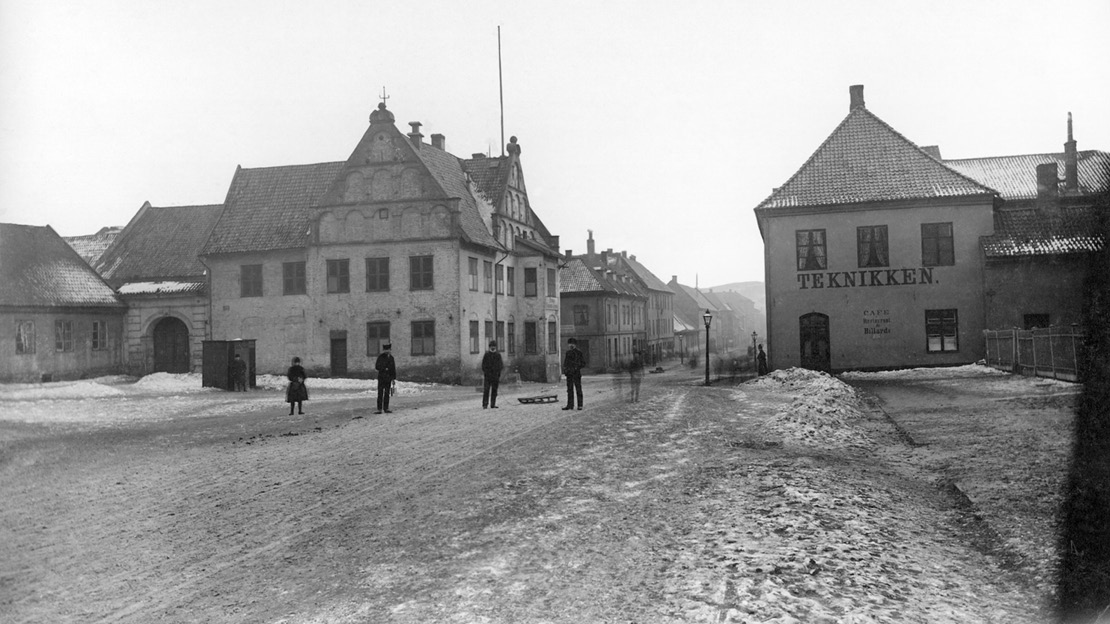
The oldest building that has been preserved from this period of new development, is Rådhusgata 19 from 1626 – the large brick building with white window frames sloping over the square.Bente Aass Solbakken
This was originally a house that was built as a residence for one of the city’s wealthy men, but over the centuries it has been used for many other things - King Fredrik V’s state administration, the Deichmanske library, the University Library, and now the Oslo Art Association.Narrator
On the other side of the street is Christiania’s first town hall. It was built with towers and stepped gables but has been restored and changed many times over the years.Bente Aass Solbakken
These two houses show the scale of the new town that grew up in the 17th century.During a building boom in the 1890s, the surrounding area of Kvadraturen was completely transformed. The 17th century town was mostly demolished and replaced with five-story apartment buildings. However, the street structure was preserved, and so too has this square, which was Christiania’s first town square!
Narrator
The scale of buildings here has also been preserved. For example, in 1996, the architect Torstein Ramberg built a complex at Akersgata 2 that frames the square with brick and glass volumes stepped towards the square itself...Bente Aass Solbakken
Throughout history, two churches previously stood on this same plot of land.The first, Holy Trinity church, burned down in 1686. It was a four-armed central church, constructed of brick and stone, with rich furnishings and surrounded by a cemetery. Lightning struck the tower, the church caught fire, and the fire spread to the surrounding houses. Instead of rebuilding the church, it was completely demolished...
Almost 200 years later, a new church was built on the same site.
The Neo-Gothic St. John’s Church, designed by the city architect Georg Andreas Bull, was built in red and yellow brick. It was a large, long church with a tall tower that towered over the cityscape. But... a difficult building site caused settlement damage, and eventually the church literally sank into the ground!!
In the spring of 1928, it too was demolished, but this time replaced with a petrol station!
Narrator
For many years, a steady stream of cars drove through here, but today the traffic is minimal, and the square is perhaps the closest you’ll get to old Christiania...Image: Christiania Square, c. 1890-1895. Foto: Unidentified photographer / Oslo Museum / Public Domain (Digitalt Museum)