516 Architecture Walk
The Bank Square
Narrator
Norges Bank, the central bank of Norway, has been located on this square in various buildings since 1823, hence where the location got its name - Bankplassen.Its first home was in what is now The National Museum – Architecture, found close by on Kongens gate.
The building was later converted into a museum with an extension by the architect Sverre Fehn in 2008.
Here is Victoria Bugge Øye, curator at The National Museum, to tell us more...
Victoria Bugge Øye
The original architect, Christian Heinrich Grosch, was an important architect for new institutional buildings in the first period of the union with Sweden throughout the 19th century.In addition to this building, Grosch also designed the Stock Exchange and the university buildings on Karl Johan gate.
The classicist style had experienced a renaissance after the Napoleonic era as an expression of republican values, and was well suited to a newly established nation-state.
Grosch also designed another building that used to stand at bankplassen - The Christiania Theater.
The theatre was built in 1837 and had space to cater for 800 patrons to enjoy the performing artists.
Narrator
Oslo’s oldest restaurant, Engebret Café, located just on the corner of the square, then became the local café for all the theatre’s actors, as well as the city’s writers and artists at the time.Victoria Bugge Øye
The theater created a bustling environment, and bankplassen became the place to be!However, at the turn of the 20th century, a new National Theater opened at another location in the city, and took over from Christiania Theater as the national stage. Grosch’s building was demolished, and Norges Bank took over the site.
Narrator
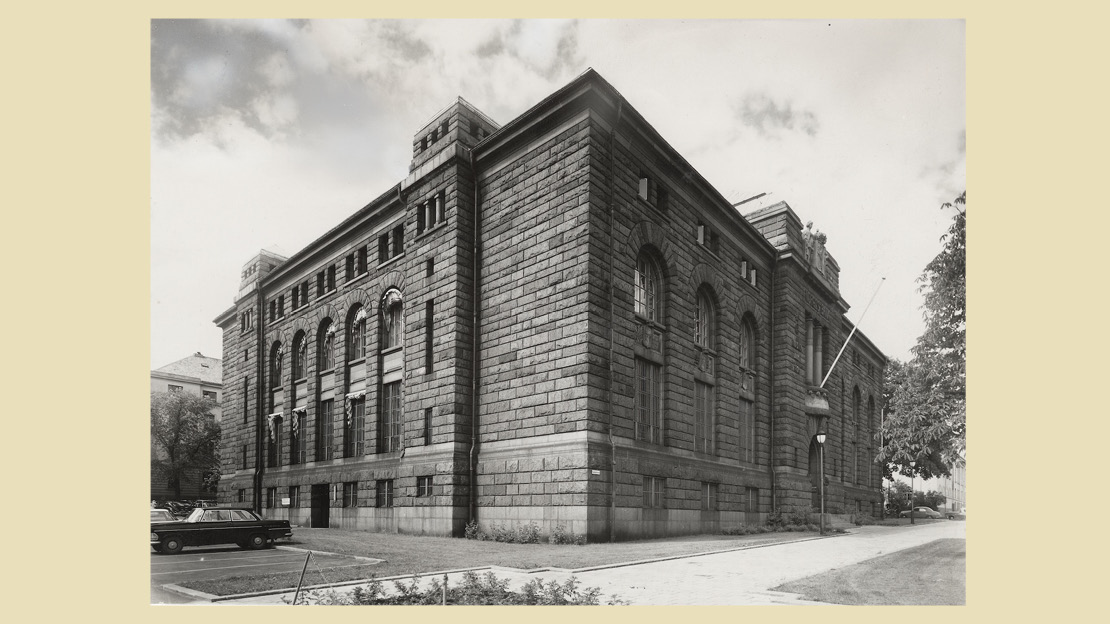
The largest building currently on the square, designed by the architect Ingvar Magnus Olsen Hjort, was originally built for Norges bank as its head office.Victoria Bugge Øye
The building was also home to The Museum of Contemporary Art for some time until the museum became part of The National Museum, and later moved to the museum’s new location at Vestbannen.Olsen Hjort also designed the old Museum of Decorative Arts and Design at St. Olavs gate which has also since become part of The National Museum.
Narrator
In the 1970s, the Bank of Norway saw the need for a new bank building at Bankplassen once again. This time, the architectural firm Lund and Slaatto was put in charge of the design.Victoria Bugge Øye
Situated on Kirkegaten, the building, with its many glass windows, is still home to Norges Bank.The façade mimics the scale and materials of the historic neighborhood it sits in and signals a growing interest in historical references and site-specific design that was typical of the era.
The solid copper-colored entrance doors gleam like a polished coin, and the building’s shimmering interiors in brass and chrome reflect the early 80s financial golden age, with high oil prices and the release of credit limits.
Image: Ingvar Magnus Olsen Hjort, Bankplassen 4 / Museet for Samtidskunst, 1907 (1899–1906). Photo: Teigens Fotoatelier / DEXTRA Photo / Norsk Teknisk Museum