606 Temp 1 og 2
Edvard Munch
Asta Nørregaard
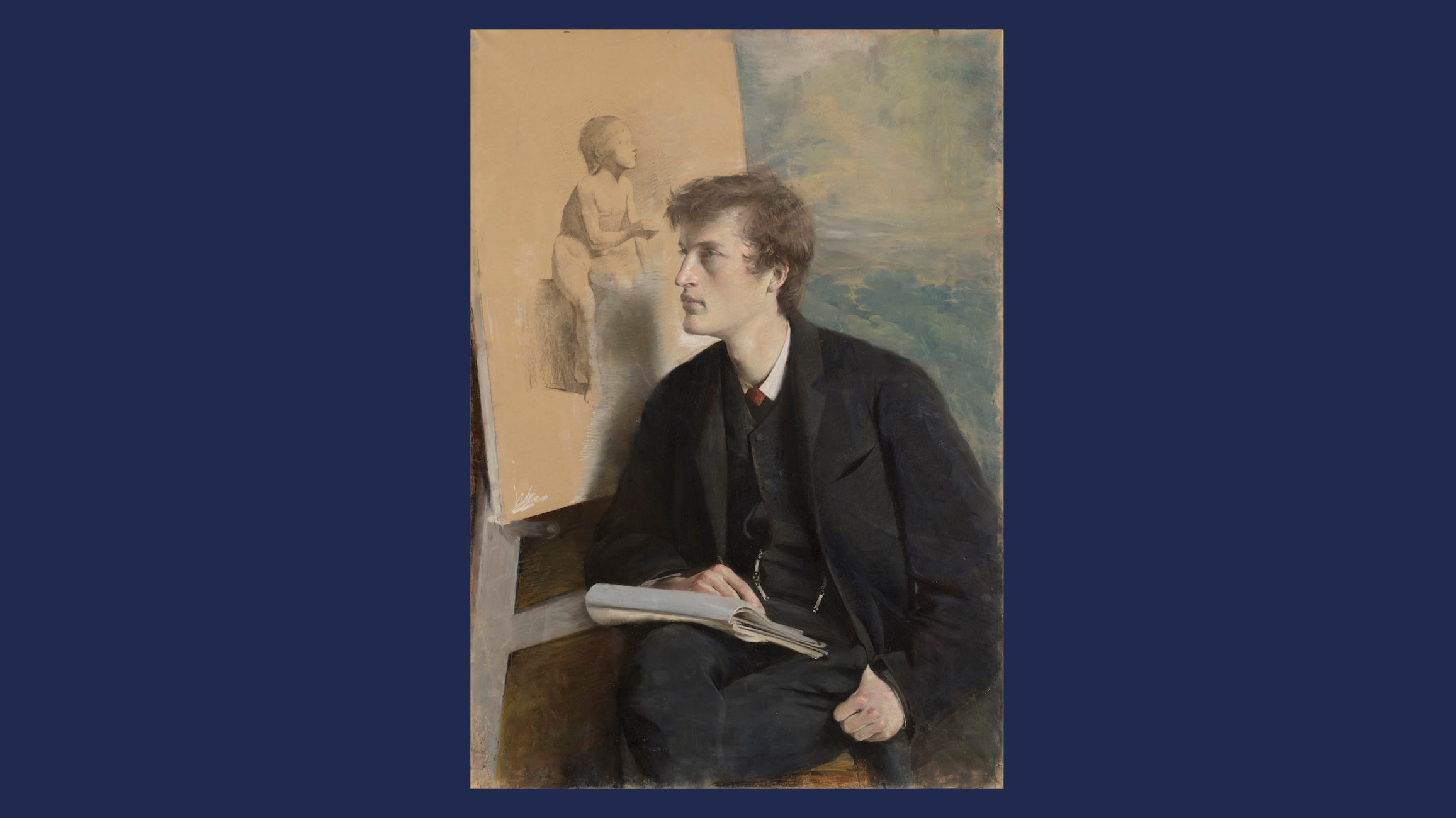
We see a young Edvard Munch.
The portrait was painted one year before he painted The Sick Child in 1886 and had his breakthrough as an artist.
Nørregaard depicts him with a sketchbook on his lap in front of an unfinished canvas on an easel that shows a classic figure study. The motif on the canvas is far from what Munch would later become known for.
Edvard Munch was ten years younger than Asta Nørregaard.
We don’t know the connection between the two, but they must have known each other well enough in order for him to have modelled for her.
Nørregaard has portrayed Munch as a sensitive, young man.
He’s correctly dressed in shirt, tie and suit jacket, depicted in profile with his characteristic silhouette, as he stares thoughtfully into the room or at something outside the picture.
The portrait is created in pastel – a technique Nørregaard would refine and make her trademark. Pastel was suitable for bringing out different textiles, textures and skin. And this can be seen in the rendering of his face and suit.
In 1885, Nørregaard participated with this portrait at the World Exhibition in Antwerp, where Munch showed the painting Inger Munch in Black – a portrait of his sister, who was five years younger.
They travelled there together by train and boat, and later both went on to Paris. But… even here they probably had different interests, and as artists they would go in very different directions.
While Munch broke with academic painting, Nørregaard stood firm by these painting principles of equality, beauty and harmony.
This portrait came into the possession of Munch's sister, Inger Munch, who later gave it to the Munch Museum.
Edvard Munch made the self-portrait a central motif in his own art, but this painting is one of very few portraits of him painted by another artist.