Madonna
- Artist: Edvard Munch
- Creation date: (1894)
About
- Edvard Munch bestandskatalog
A woman shown half-length arches her back, one arm behind her head, the other behind her back. Against a background of undulating, quivering lines, she is depicted with closed eyes and seems almost to be floating. The title Madonna, a common designation for the mother of Jesus, contrasts with both the figure and the alternative title, Elskende kvinde (Amorous Woman). The female figure has a halo, but it is red rather than gold, as it would be in a religious image.
The picture combines erotic and religious associations. Here the woman is simultaneously a lover and an exalted, holy figure. One of Munch's most popular and widely discussed paintings, the work has been analysed in depth in a monograph (Ydstie (ed.) 2008). Between 1894 and 1897, Munch painted five versions of Madonna (Woll 2008, M 365; M 366; M 367; M 368; M 369). During this period, he was part of the circle that regularly met at the café-restaurant "Zum Schwarzen Ferkel" in Berlin. This was a group of artists, writers and musicians that included August Strindberg, Stanisław Przybyszewski and Dagny Juel. In addition to art and the role of the artist, the group's discussions frequently revolved around the themes of the woman, love, sexuality and the complex relationship between the sexes.
The woman is a major and recurrent theme in Munch's art, and his depictions of women are predominantly ambiguous and full of contradictions. This attitude finds expression in a text Munch wrote in connection with the Madonna painting:
Picture No. -- The woman in a state of abandon
-- acquires the painful
beauty of a Madonna --
The mystique is from an entire development
contracted into one
-- For the man, woman's equivocalness
is a mystery
The woman is all at once saint
-- whore and unhappy devotee
(Note 1894--1895, emunch.no: MM N 30)
In his pictures and writings, Munch challenged preconceptions about male and female, the masculine and the feminine. He portrayed women of different types, ranging from the young and innocent to the seductive femme fatale, the mortal woman who ensnares men and leads them to their doom. This was a popular archetype of the day that encapsulated notions of sexuality, perdition, death and artistic creativity. The femme fatale has roots in both the literature of antiquity and the Bible.
In 1894, Przybyszewski initiated the publication Das Werk des Edvard Munch. In his own contribution to the volume, Przybyszewski wrote about the six paintings that had been exhibited the previous year at Unter den Linden 19 under the title "Study for a series: 'Love'". One of these was Madonnaansiktet (Madonna-Gesicht) (The Face of Madonna):
The third picture presents a Madonna. ... a Madonna in a chemise on crumpled sheets with the halo of her impending martyrdom to childbirth, a Madonna captured at the moment when the arcane mystery of procreation's eternal rapture illuminates the woman's face with oceanic beauty ... (Przybyszewski 1894 A, translation in Vigeland + Munch 2015, 86)
This is evidently a description not of the Madonna we know, but of a forerunner that has since been lost. Even so, this passage may have influenced the way Munch developed the subject and his conception of it (Høifødt 2008, 16-17). Munch asserts the picture's concern with the relationship between life and death in his own writings, for example:
Moonlight glides over your face
full of the beauty and pain of the worldly realm
For it is now death holds out a hand to life
and a link is forged between the thousands of generations now dead
and the thousands still to come
(1896, emunch.no: MM.T.2907)
The notion of conception and human reproduction as something sacred and powerful is also echoed in the picture's reception, for example, in the remarks of Munch's friend, the poet Sigbjørn Obstfelder:
To me, his Madonna picture is the epitome of his art. She is the Madonna of the Earth, the woman who gives birth in pain. I believe, one must turn to Russian literature to find a similarly religious view of woman, a comparable glorification of the beauty of pain (...) It is just such a woman, one who carries in her womb the greatest miracle of the earth, who Munch visualises. (Obstfelder 1896, 21)
One of the Madonna pictures included in the Ugo Barroccio exhibition in Berlin in March 1895 was apparently mounted in a frame that was symbolistically embellished with sperm cells and a foetus (Thiis 1933, 218). In a lithographic version (1895--1902, Woll 2001, G 39), the female figure is contained in just such a frame, with sperm cells and a foetus in the lower left corner.
All five versions of the Madonna motif are fairly similar in terms of presentation and format. This makes it difficult to determine which were shown in Munch's earliest exhibitions. The first showing of a version of the work was at the art dealership Blanch in Stockholm in 1894 (Woll 2008, 352). There it featured in a sequence entitled "Studies for a mood series: Love". In the catalogue there are two items with the title Kvinnan som älskar (The Amorous Woman). Munch exhibited two versions of the Madonna theme simultaneously in a number of exhibitions, for example at Barroccio in March 1895. There they were included in the sequence "Die Liebe". In this case, one painting had the title Madonna, the other Das liebende Weib (The Amorous Woman).
The picture was gifted to the National Gallery in 1909 by Olaf Schou. None of the five existing versions of Madonna carries a date, making it difficult to determine their chronological order. They have traditionally been dated between 1894 and 1897. Gerd Woll adopts the order proposed by Cornelia Gerner, in which the National Gallery's version comes second (Gerner 1993, 21, 1990 in the bibliography, PhD thesis). Recent research has confirmed that the National Museum's Madonna is the first in the series (Ford, 2022, 49). There exist two graphic versions of Madonna, the etching from 1894 (Woll 2001, G 11) that was included in the portfolio edition of Munch prints published in that year by the German critic and writer Julius Meier-Graefe, and a lithograph (1895/1902) (The National Museum, NG.K&H.A.19515, NG.K&H.A.19516; Woll 2001, G 39). Several drawings indicate how Munch developed the subject (The Munch Museum, MM.T.0291; MM.T.2430).
Madonna was shown at Munch's exhibition in Leipzig at P.H. Beyer & Sohn in 1903. There he presented what would later become known as the Frieze of Life as a coherent series. Documentary photographs from the exhibition show that *Madonna *was hung to the left of Ashes (The National Museum) in the second section, which dealt with the flowering and fall of love (Woll 2008 B, M 400).
Wenche Volle
The text was first published in Edvard Munch in the National Museum. A comprehensive overview (Oslo: National Museum, 2022).
- Creation date:
- (1894)
- Object type:
- Painting
- Materials and techniques:
- Olje på lerret
- Material:
- Canvas
- Dimensions:
- Width: 70.5 cm
- Height: 90.5 cm
- Keywords:
- Visual art
- Classification:
- 532 - Bildende kunst
- Motif - type:
- Nude, Portrait
- Inventory no.:
- NG.M.00841
- Cataloguing level:
- Single object
- Inscriptions:
- Primary, Signature, nede venstre: E Munch
- Acquisition:
- Gift from Olaf Schou 1909
- Provenance:
- [40] Previous owner, Olaf Schou
- Owner and collection:
- Nasjonalmuseet for kunst, arkitektur og design, The Fine Art Collections
- Photo:
- Børre Høstland
- Hansen, Vibeke Waallann, et al. Edvard Munch i Nasjonalmuseet: en samlet oversikt. Redigert av Ustvedt, Øystein, et al. Oslo: Nasjonalmuseet, 2022. kat.nr. 29.
- Ford, Thierry, et al. «Munch and optical coherence tomography: unravelling historical and artist applied varnish layers in painting collections». European Physical Journal Plus, 2021. https://link.springer.com/article/10.1140/epjp/s13360-021-01758-5. [upaginert]
- Vassenden, Erik. «Liv, bilde, fortelling. Narrative mønstre i Edvard Munchs ‘Livsfrise’"», i «I oss er verdener», utstillingskatalog, 2019. 26.
- Ustvedt, Øystein. Munch: En introduksjon til bildene og livet. Oslo: Stenersens forlag, 2018. 73–8.
- Berman, Patricia G. «Edvard Munch’s Woman: The Construction of an Archetype», i «Edvard Munch. Archetypes», utstillingskatalog, 2016. 91–2.
- Alarcó, Paloma. «Edvard Munch. Archetypes», i «Edvard Munch. Archetypes», utstillingskatalog, 2015. 38, 91–2.
- Eggum, Arne. «The Scream as a vision of despair», i «Keys to a Passion», utstillingskatalog, 2015. 195, 197.
- Clarke, Jay. «Art and Life - Munch and Biography», i «Edvard Munch and the Modern Soul», utstillingskatalog, 2014. 54.
- Steihaug, Jon-Ove. «Edvard Munch’s Dramatic Art», i «Edvard Munch and the Modern Soul», utstillingskatalog, 2014. 32.
- Guleng, Mai Britt. «Livsfrisens fortellinger. Edvard Munchs bildeserier», i «Edvard Munch 1863-1944», 2013. 133.
- Owesen, Ingeborg W. «Edvard Munch mellom kvinnesak, kjønn og kjærlighet», i «Edvard Munch 1863-1944», utstillingskatalog, 2013. 302.
- Berman, Patricia G. «Çoğaltma, ekleme, çikarma. Warhol, Munch ve çoğaltilmiş baski», i «Munch/Warhol», utstillingskatalog, 2013. 30.
- Bjerke, Øivind Storm. «Edvard Munch og Røros», i «Kunst i Bergstaden», utstillingskatalog, 2013. 16–8.
- Mørstad, Erik. «Munch and the literary». Kunst og kultur 96, nr. 4 (2013). 213.
- Sjåstad, Øystein. «Das Bild von Oda Krohg als ’eine wahre Boheme-Prinzessin», i «Oda Krohg. Malerin und Muse im Kreis um Edvard Munch», utstillingskatalog, 2011. 36.
- Sjåstad, Øystein. «Absorbert og teatralt i Christian Krohgs og Edvard Munchs kunst». Kunst og kultur 93, nr. 3 (2010). 176.
- Alessandrini, Marco. La mente spiegata da Edvard Munch. Psicoanalisi in dialogo con un artista. Roma: Edizione Magi, 2009. 100.
- Woll, Gerd. Edvard Munch: Samlede malerier: B. 1: 1880-1897. Oslo: Cappelen Damm, 2008. kat.nr. 366.
- Rutkowski, Eva. Edvard Munch’s Frauen: Frauendarstellung in der frühen Gemälden des norwegischen Malers Edvard Munch. Saarbrücken: Wdm Müller, 2008. 38–9, 46.
- Woll, Gerd. «Bruk og gjenbruk i Munchs tidligste malerier», i «Munch blir ‘Munch’. Kunstneriske strategier 1880-1892», utstillingskatalog, 2008. 100.
- Høifødt, Frank. «Munchs Madonna - drøm og visjon = Munch’s Madonna - Dream and Vision», i «Madonna = Madonna», utstillingskatalog, 2008. 13, 46.
- Ydstie, Ingebjørg, red. «Dateringen av Munch-museets Skrik = The Dating of the Munch Museum’s Scream», i «Skrik = The Scream», utstillingskatalog, 2008.
- Müller-Westermann, Iris. Munch själv. Utstillingskatalog. Stockholm: Moderna Museet, 2005. 32, 50–1.
- Buchhart, Dieter. «Das verschwinden im Werk Edvard Munchs. Experimente mit Materialisierung und Dematerialisierung». [upublisert avhandling, doktorgrad]. Universität Wien, 2004. 118.
- Thurmann-Moe, Jan. Edvard Munchs «hestekur»: eksperimenter med teknikk og materialer. Oslo: Munchmuseet, 1995. 38.
- Gerner, Cornelia. Die «Madonna» in Edvard Munchs Werk: Frauenbilder und Frauenbild im ausgehenden 19. Jahrhundert. Morsbach: Literaturverlag Norden Max Reinhardt, 1993. 21.
- Nasjonalgalleriet, red. Norske malerier. Katalog. Oslo, 1992. 340.
- Heller, Reinhold. Munch: his life and work. London: John Murray, 1984. 127–8.
- Nasjonalgalleriet, red. Katalog over norsk malerkunst: med 158 illustrasjoner. Oslo, 1968. kat.nr. 1279.
- Nasjonalgalleriet, red. Katalog over norsk malerkunst. Oslo, 1950. kat.nr. 1062.
- Stenersen, Rolf. Edvard Munch: Nærbilde av et geni. Oslo: Gyldendal, 1945. 109, 147.
- Nasjonalgalleriet, red. Norsk malerkunst i Nasjonalgalleriet. Oslo, 1933. kat.nr. 950.
- Thiis, Jens. Edvard Munch og hans samtid: Slekten, livet og kunsten, geniet. Oslo: Gyldendal, 1933. 216–7.
- Nasjonalgalleriet, red. Edvard Munch. Utstillingskatalog. Oslo, 1927. kat.nr. 78.
Nasjonalmuseet's collection catalogue is a living resource of information gathered since the 1830's. Some records may contain language or ideas that today could be perceived as outdated, offensive or discriminatory with regard to for instance gender, sexuality, ethnicity or disability, and that may be at odds with the museum's values regarding equality and diversity.
Do you have suggestions for how this record can be improved? We would like to hear from you!
If you would like more information about specific objects in the collection or about objects that haven't been published online, please contact the museum. You can read more about how we work with the collection and our cataloguing practice here.
Other works by Edvard Munch
 The KissEdvard Munch1892
 MoonlightEdvard Munch(1893)
 Julius Meier-GraefeEdvard MunchAntagelig 1894
 From Vestre AkerEdvard Munch1881
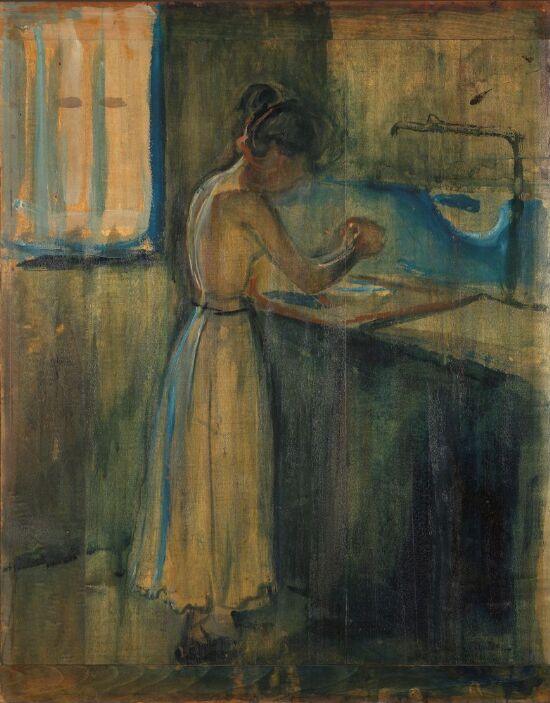 Young Woman Washing herselfEdvard Munch(1896)
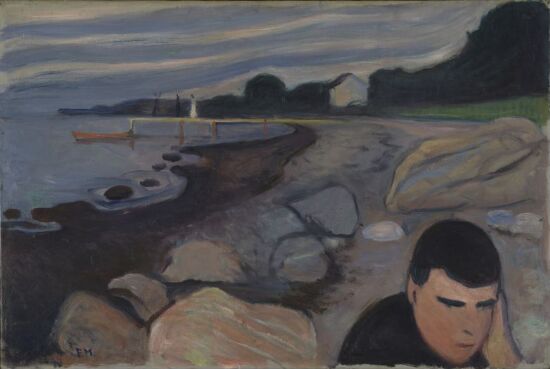 MelancholyEdvard MunchAntagelig 1892
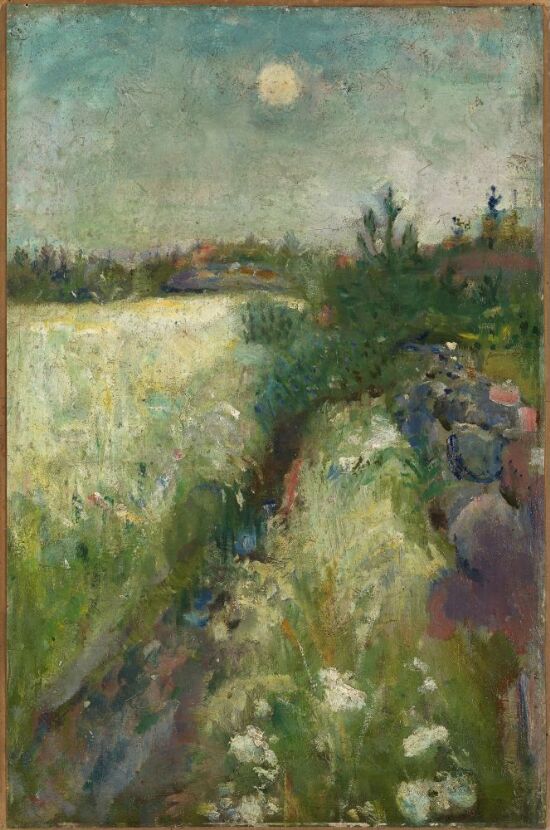 Flowery Meadow at VeierlandEdvard Munch(1887)
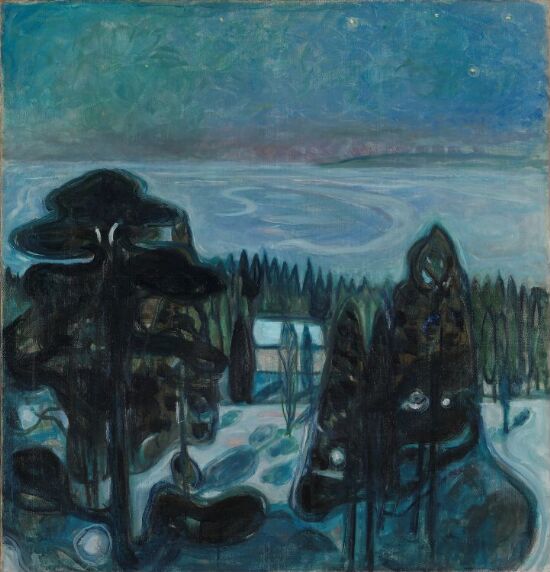 White NightEdvard MunchPåbegynt 1900, avsluttet 1901
 Rue LafayetteEdvard Munch1891
 Naked Woman in Front of a HouseEdvard Munch1883 eller 1884
 Self-PortraitEdvard Munch1905
 Hjørdis GierløffEdvard MunchPlaten utført 1913 eller 1914; trykket 1914