Hannah Ryggen
- Born:
- 21.03.1894 in Malmø
- Death:
- 02.02.1970 in Trondheim
- Nationality:
- Norway
- Works in the collection (published):
- 17
- Exhibitions (published):
- 1
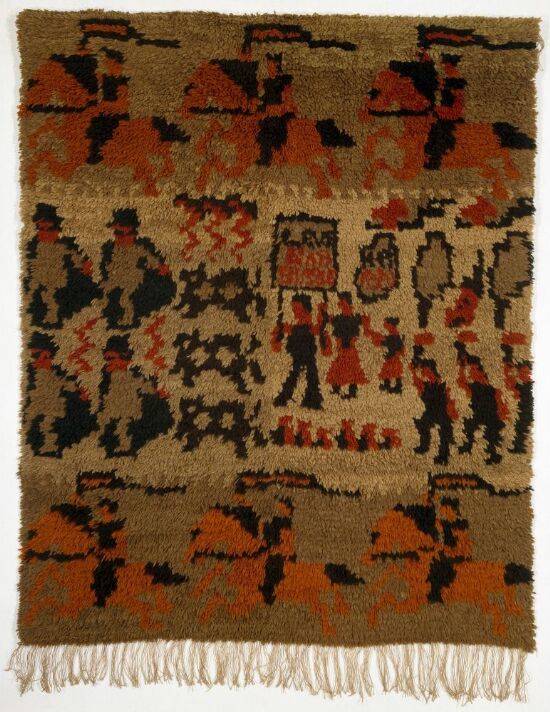
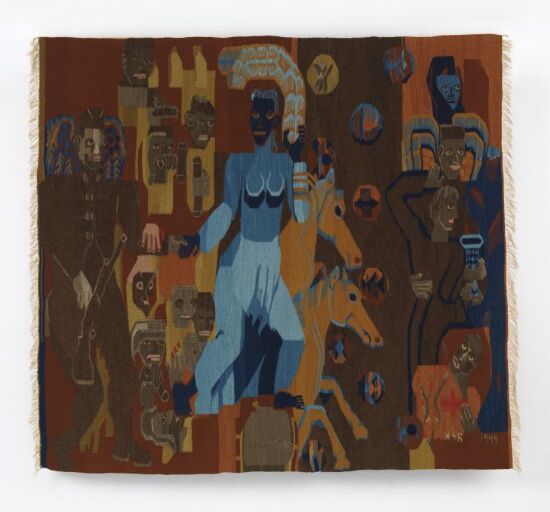
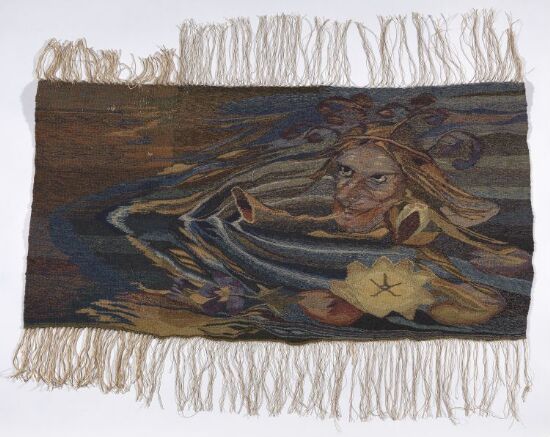
Opposition to war, the abuse of power and social injustice were all subjects that Hannah Ryggen wove into her tapestries.
Several of Ryggen’s works arose as direct reactions to the political events of the time as they were reported in the press, such as Fishing in the Sea of Debt (1933). This work addresses the difficult conditions people faced when the Great Depression struck Norway in the 1930s.
Ryggen grew up in a working-class environment in Malmö, Sweden, and trained as a teacher. During the day she taught school, and in the evenings she studied under the artist Fredrik Krebs at Tekniska Skolan in Lund. During a study tour to Dresden she met the Norwegian painter Hans Ryggen, whom she later married. The young couple moved to Norway and lived in a newly built house at the family farm in Ørlandet.
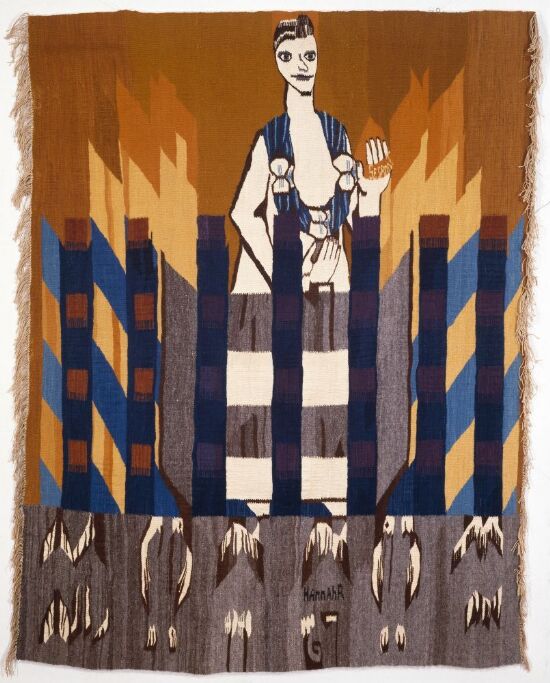
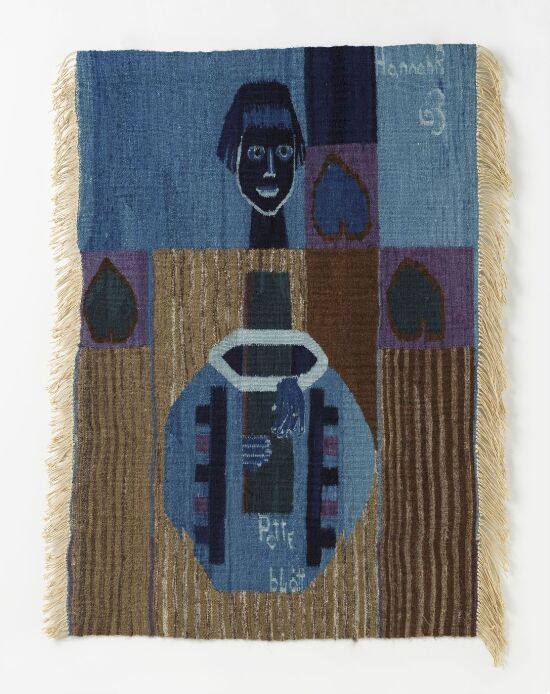
Blue was her favourite colour
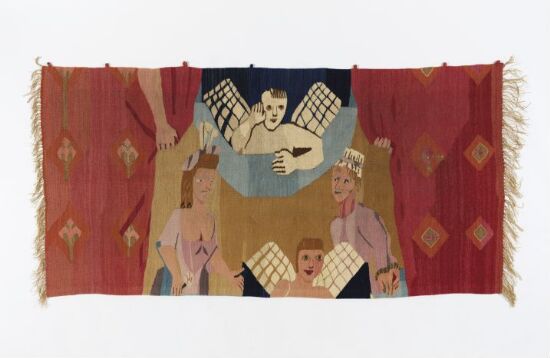
Ryggen was self-taught with regard to both technique and materials. She often controlled the entire artistic process, and carded, spun and dyed the yarn herself. Her plant-dyed woollen yarns and topical political motifs helped to raise tapestry-making from a type of handicraft to an art form.
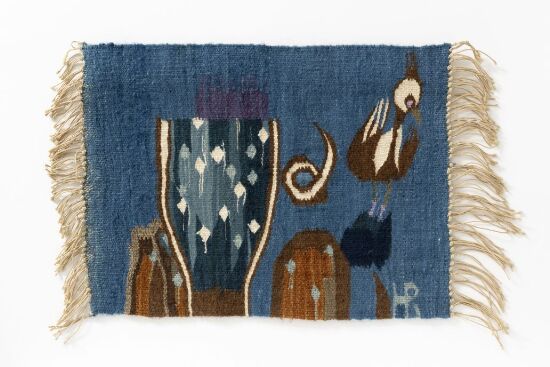
There was always a urine pot on hand for guests to use, because Ryggen needed male urine. A blue hue made with the aid of urine became the main colour she used in her tapestries, and symbolised the positive aspects of life as well as longing and dreams. The self-portrait Pot Blue (1963) illustrates her connection with that colour in particular.
The horrors of war
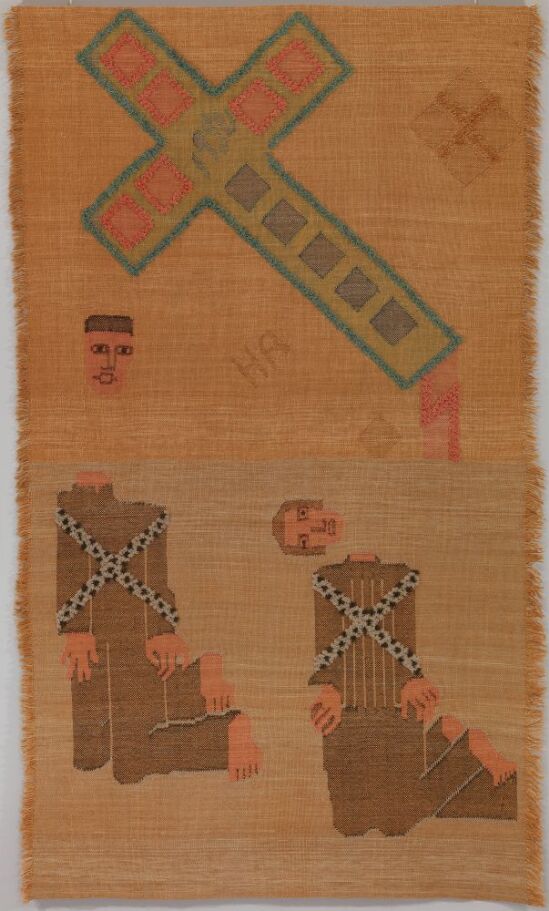
Many of Hannah Ryggen’s tapestries focused on her activism. From the 1930s onward the struggle against war, fascism and social injustice characterised her works. Ethiopia (1935) depicted Italy’s attack on the African country. It was the first in a number of iconic works associated with the battle against the reign of terror represented by fascism and nazism.
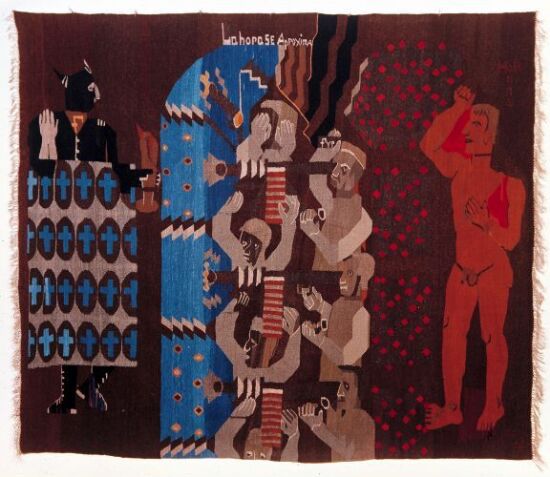
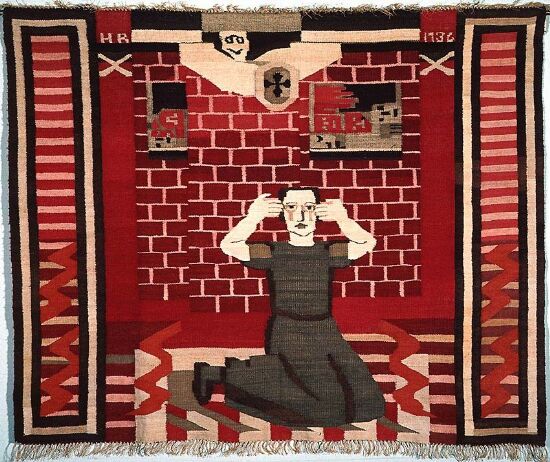
The Spanish Civil War was the third-most frequently mentioned topic in the Norwegian press in 1935. Two of Ryggen’s best-known works in the National Museum’s collection arose from events that occurred during that war: Horror in 1936 and Spain in 1938. In the former she addressed one of the most horrific of the Civil War’s events: the bombing of cities, using the civil population as a target. In Spain and the text woven into the image, "La hora se aproxima" ("The time is approaching"), the people’s troops are turning against General Franco, the leader of the Nationalist forces.
During the war years Ryggen wove several tapestries protesting again the German abuse of power, and honouring Norwegians who died defending freedom. She also wove the tapestry Grini in 1945, portraying her husband, Hans, who had been arrested and was incarcerated in Grini prison camp.
The eternal activist
In the tapestry Blood in the Grass (1968), Ryggen attacked the aggressive American bombing of North Vietnam, where chemical weapons such as napalm and Agent Orange were used. Once again it was the civil population who suffered.
22 July 2011
The work We Live On a Star (1958) was commissioned for the new high-rise government building designed by architect Erling Viksjø in Oslo. The naked couple and the children symbolise the eternal renewal of life. They are standing on planet Earth, which is floating in space together with other planets and stars. This image may have been inspired by the science fiction epic Aniara, a work about the destruction of the world, featuring people who have escaped in a spaceship that is gliding aimlessly through the cosmos. The text on the label mounted near the work read: “The mysteries of the universe and the important role played by love on our Earth.”
Over 50 years after the tapestry was mounted in the government building it gained renewed relevance when Norway was subjected to a terrorist attack by a Norwegian who espoused an ideology inspired by fascism and nazism, outlooks that Ryggen combatted through her artistic practice. She was a freedom fighter and peace activist her entire life. The loom was her principal weapon against injustice, abuse of power and human debasement.
Literature
Books
- Martinson, Harry. Aniara: en revy om Mennekset i tid og rom. Pax, 2006. (English version: Aniara: An Epic Science Fiction Poem. Story Line Press, 1999.)
- Paasche, Marit. Hannah Ryggen: Threads of Defiance. Thames & Hudson, 2019.
- Ustvedt, Øystein (ed.). Hannah Ryggen: verden i veven. Nasjonalmuseet and Moderna museet, 2015.
Encyclopedia
- Norsk kunstnerleksikon
- Norsk biografisk leksikon
- Store norske leksikon
Biography
- Born: Malmö, Sweden, 1894
- Died: Trondheim, Norway, 1970
- Parents: Gustav Jönsson, shopman and seaman, and Karna Gall, cook
- Education: Fredrik Krebs’s painting school in Lund, 1916-1922
- Married the Norwegian painter Hans Ryggen (1894-1956) in 1923, moved with him to Ørlandet by the Trondheim Fjord
- Child: Mona, born 1924
- First solo exhibition: Lund, 1926
- Her tapestries were shown at world fairs in Paris, 1937, and New York City, 1939
- First textile artist whose work was purchased by the National Gallery (The Use of Hands, 1949, purchased 1953)
- Awarded the Prince Eugen medal in gold by the Swedish government, 1959
- Awarded the Norwegian government artists’ grant starting in 1961
- First textile artist whose work was included in the Annual Autumn Exhibition, Oslo, 1962
- Accepted as a member of the Royal Swedish Academy of Fine Arts, 1962
- First textile artist to participate in the Venice Biennale, 1964
- Named Officer of the Royal Norwegian Order of St Olav, 1965
- Several public art commissions and works in public collections
- Created over 100 large tapestries, many of which are found in Scandinavian museums and public buildings. The largest collection is at the Hannah Ryggen hall at the National Museum of Decorative Arts and Design, Trondheim
Works in the collection (published)