About
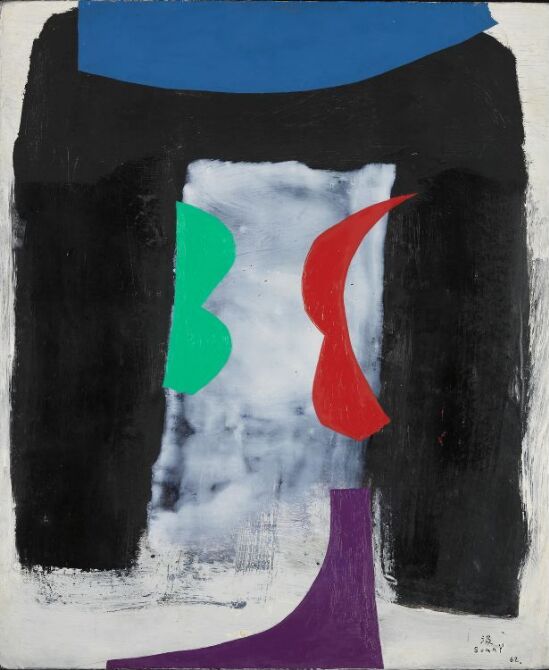
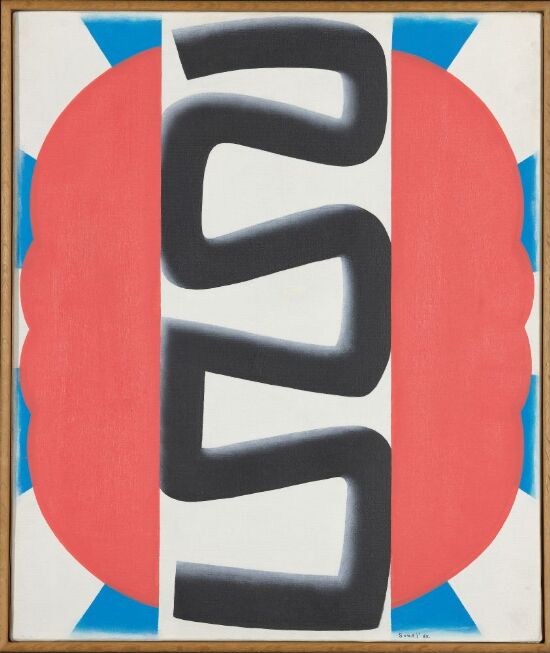
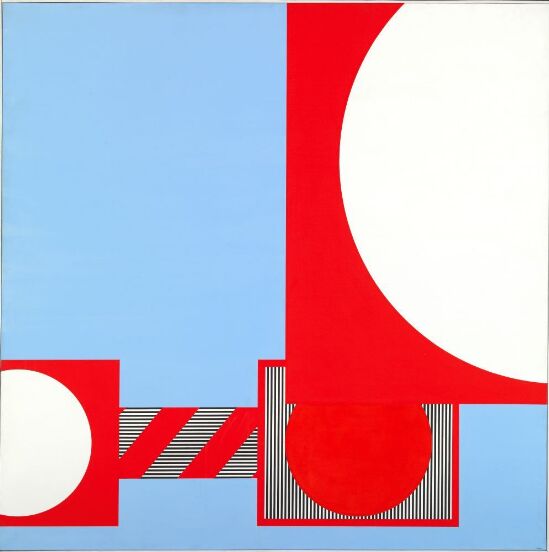
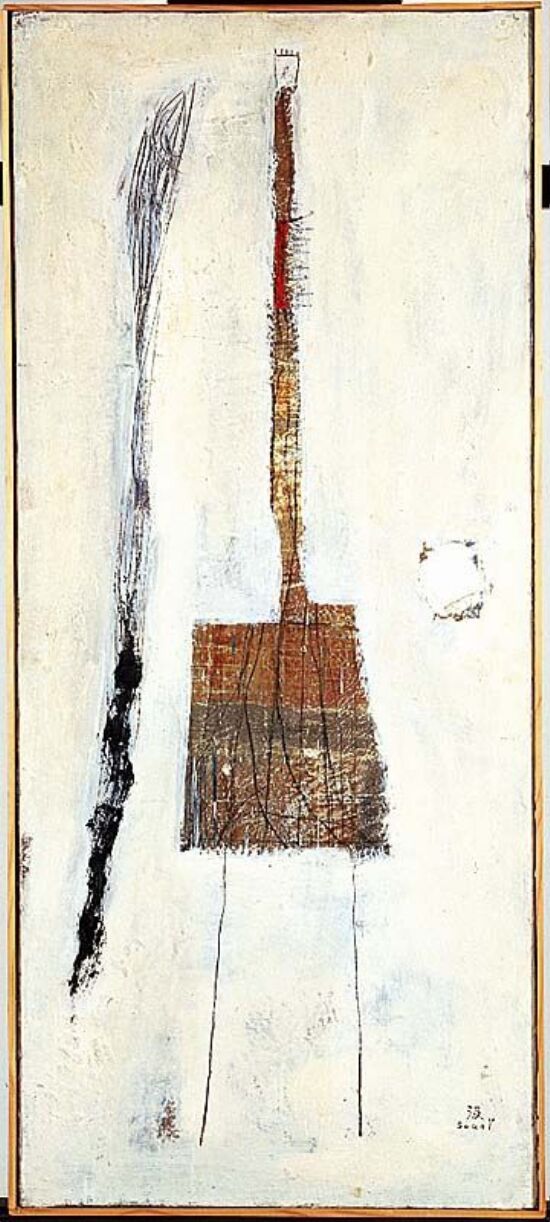
Kumi Sugaï was one of Japan’s foremost contemporary artists and printmakers. Before the Second World War he trained to be an artist in Kobe, Japan. After the war he travelled around Europe, eventually settling in Paris. In his earliest works he mixed the woodcut techniques of the traditional Japanese genre of ukiyo-e, a style of art that had developed in Japan during the Edo period (1603–1867), with imagery that alluded to the Western world. The early Japanese style, which was particularly used for commercial purposes, was well-suited as a fundament for pursuing the pop art ideal of showing everyday scenes, ideals that also influenced Sugaï.
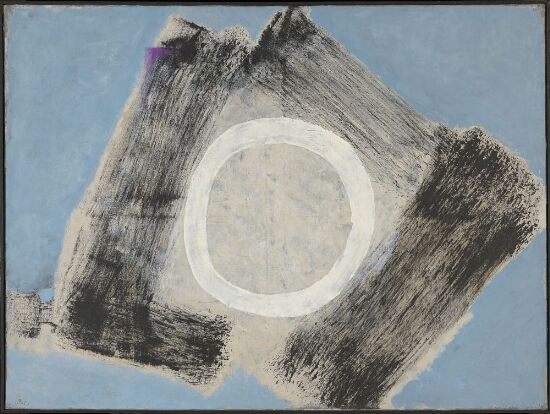
Sugaï achieved his international breakthrough in the 1950s with his abstract hard-edge pictures, which often juxtaposed contrasting colours and shapes. These pictures, and their monochromatic fields of colour, expunged all sign of the artist’s hand. The late 1950s, however, witnessed a striking turn in Sugaï’s art, as he gradually eschewed the abstract, vividly colourful images in favour of more calligraphic works and their earthier hues. Traditional Japanese heritage seems to have become ever more important to him, and as in Jichin the imagery was often based on Japanese script. Printmaking was supplanted by oil painting, mass-produced editions by individual works. His style became more liberated, and the traces of the artist’s hand became more evident.
- Creation date:
- 1958
- Object type:
- Painting
- Technique and material:
- Olje på lerret
- Material:
- Canvas
- Dimensions:
- Height: 129.5 cm
- Width: 195 cm
- Keywords:
- Visual art
- Classification:
- 532 - Bildende kunst
- Inventory no.:
- MS-02980-1988
- Cataloguing level:
- Single object
- Acquisition:
- Gave fra Nasjonalgalleriets Venner 1961
- Owner and collection:
- Nasjonalmuseet for kunst, arkitektur og design, The Fine Art Collections
- Photo:
- Høstland, Børre
- Copyright:
- © Sugaï, Kumi/BONO
Nasjonalmuseet's collection catalogue is a living resource of information gathered since the 1830's. Some records may contain language or ideas that today could be perceived as outdated, offensive or discriminatory with regard to for instance gender, sexuality, ethnicity or disability, and that may be at odds with the museum's values regarding equality and diversity.
Do you have suggestions for how this record can be improved? We would like to hear from you!
If you would like more information about specific objects in the collection or about objects that haven't been published online, please contact the museum. You can read more about how we work with the collection and our cataloguing practice here.