Die Fast and Quiet When They Interrogate You or Live So Long That They are Ashamed to Hurt You Anymore
- Artist: Jenny Holzer
- Creation date: (1983–1985)
About
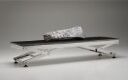
The eponymous sentence engraved on a plain aluminium sign as part of Jenny Holzer’s “Survival” series (1983–85) is direct and brutal. Language is a key component in all of Holzer’s works, where words are used for artistic effect. The aluminium sign in this piece resembles similar signs that are put up in public places to convey brief information or commands and instructions.
The use of language in the visual arts clashes with an artistic philosophy that emphasizes the artist’s personal technique or style. Holzer works within an art form that appropriates elements from mass media and the language of everyday life so as to question conventional notions about what art is. Many of her textual works are idiomatic expressions that are deliberately ambiguous. A hallmark of Holzer’s art is her use of what she calls “truisms”, slogan-like sentences written in what seems to be a plain and truthful style. She began exploring this art form in 1977 upon moving to Manhattan, a metropolitan environment teeming with billboards and neon signs. She uses a language-based approach taken from conceptual artists such as Joseph Kosuth and Lawrence Weiner. But Holzer’s textual works are more exhortative and directly political. They parody the authoritarian voices of power and highlight how we are influenced by mass media and advertising every single day.
- Creation date:
- (1983–1985)
- Object type:
- Sculpture
- Technique and material:
- emalje på aluminium
- Material:
- Aluminium
- Dimensions:
- Height: 38 cm
- Width: 46 cm
- Edition:
- 5/26
- Keywords:
- Visual art
- Classification:
- 532 - Bildende kunst
- Inventory no.:
- MS-04045-1998
- Cataloguing level:
- Single object
- Acquisition:
- Kjøpt 1998
- Owner and collection:
- Nasjonalmuseet for kunst, arkitektur og design, The Fine Art Collections
- Photo:
- Børre Høstland
- Copyright:
- © Holzer, Jenny/BONO
Nasjonalmuseet's collection catalogue is a living resource of information gathered since the 1830's. Some records may contain language or ideas that today could be perceived as outdated, offensive or discriminatory with regard to for instance gender, sexuality, ethnicity or disability, and that may be at odds with the museum's values regarding equality and diversity.
Do you have suggestions for how this record can be improved? We would like to hear from you!
If you would like more information about specific objects in the collection or about objects that haven't been published online, please contact the museum. You can read more about how we work with the collection and our cataloguing practice here.