Moonlight
- Artist: Edvard Munch
- Creation date: (1893)
About
A finely tuned interplay of contrasts is one of the defining features of this evocative painting. Intense, cool moonlight falls on a picket fence and a window frame behind the woman in the foreground, while also illuminating her pale face. The rest of the woman’s figure, together with the shadow on the wall and the garden, lies in muffled obscurity. Here we find shapes with concise, undulating contours that stand in contrast with the rhythmically patterned, rectangular forms of the fence and the house. Set against these flat, frontal elements, the woman’s shadow and the sections of fence and wall create an element of depth in the composition. But the visual components are not in themselves what matter most; the concise, underlying mood is one of loneliness, yearning and angst.
Munch painted this picture in summer 1893 at Åsgårdstrand, where he also painted The Voice (now in the Munch Museum), which tackles a related theme. Three years later he returned to this motif in a woodcut.
The painting was purchased for the National Gallery in 1938 with funds donated by Olaf Schou, with a contribution from Marit Nørregaard.
- Edvard Munch collection catalogue
A woman in a dark dress and hat stands in front of a yellow weatherboard house with a white picket fence. The landscape beyond lies in darkness, while the wall of the house, the fence and the woman's face are lit by bright moonlight. The features of the face are somewhat blurred. Although the title refers to moonlight, it is the female figure who catches the eye. The white-painted fence and window frame stand out prominently. So too does the moon reflected in the window pane. The dark green shadow of the woman on the wall of the house has an undulating contour that contrasts with the picture's more rigorous vertical and horizontal elements. By means of these formal devices, Munch imbues a simple, everyday situation with a mood of mystery. The stylisation of details and a shallow pictorial depth create the impression of a stage set. The woman stands close to us, reducing the distance between the space of the picture and that of the viewer. Moonlight was probably painted in Åsgårdstrand in summer 1893. Two drawings of similar composition suggest that Munch was developing this theme while staying there, and that he used a model (sketchbook MM.T.00129).
Although the woman's frontal pose is typical of Munch's paintings during this period, the approach to colour distinguishes this work from most of the others that date from 1893. There are, however, a few from that summer that explore the same dark palette. It has been suggested that these reflect Munch's interest in the symbolist paintings of Arnold Böcklin. He was familiar with the Swiss artist's works, many of which he had seen during a visit to the Hamburger Kunsthalle in autumn 1891 (Eggum 1983, 98).
Thematically, the painting can be understood in a variety of ways. One approach stresses the biographical perspective. The female figure has been interpreted as a recollection and representation of the young Munch's first love, whom he refers to in his private notes as "Mrs Heiberg" (Billeter 1998, 125). The picture has also been compared to Sommernattsdrøm. Stemmen (Summer Night's Dream. The Voice) (Woll M 319), which was painted the same year. Both works have been interpreted as portrayals of female desire and of the desirous male gaze for the woman (Mørstad 2003, 86). The face, the reflection of the full moon in the window, and the white and red flowers have been seen as metaphors for the cycles of nature, the moon and the female body (Varnedoe 1982, 190).
The painting was first exhibited in Berlin in December 1893. Other related works include the Hus i måneskinn (House in Moonlight) (Woll M 323), owned by KODE Art Museums and Composer Homes, Bergen, and two pencil drawings in a sketchbook owned by the Munch Museum. Munch also made two colour woodcuts based on the same subject, in 1896 and 1901. For these he chose just a section of the figure, such that the woman's face dominates the picture (Woll G 90; Woll G 202). The painting was purchased for the collection in 1938 with financial support from the Olaf Schou endowment. '
Vibeke Waallann Hansen The text was first published in Edvard Munch in the National Museum. A comprehensive overview (Oslo: National Museum, 2022).
- Creation date:
- (1893)
- Other titles:
- Måneskinn (NOR)
- Object type:
- Painting
- Materials and techniques:
- Olje på lerret
- Material:
- Canvas
- Dimensions:
- Height: 140.5 cm
- Width: 137 cm
- Keywords:
- Visual art
- Classification:
- 532 - Bildende kunst
- Inventory no.:
- NG.M.01914
- Cataloguing level:
- Single object
- Inscriptions:
- Primary, Signature, nede høyre: E. Munch
- Acquisition:
- Purchased 1938
- Provenance:
- [40] Previous owner, Harald Nørregaard
[30] Seller to the museum, Wang Kunsthandel - Owner and collection:
- Nasjonalmuseet for kunst, arkitektur og design, The Fine Art Collections
- Photo:
- Børre Høstland/Lathion, Jacques/Jacques Lathion
- Det magiske nord. Finsk og norsk kunst rundt 1900 (Hovedtittel/ anvendt/ Norsk)Helsinki, Finland(2015)Dreams of a summer night. Scandinavian painting at the turn of the centuryLondon, Storbritannia(1986)
- Hansen, Vibeke Waallann, et al. Edvard Munch i Nasjonalmuseet: en samlet oversikt. Redigert av Ustvedt, Øystein, et al. Oslo: Nasjonalmuseet, 2022. kat.nr. 21.
- Bal, Mieke. Emma and Edvard Looking Sideways: Loneliness and the Cinematic. Oslo: Munchmuseet, 2017. 172.
- Huusko, Timo, et al. Det magiske nord: finsk og norsk kunst omkring 1900. Oslo: Nasjonalmuseet, 2015. 234; kat.nr. 98.
- Flaatten, Hans-Martin Frydenberg. Edvard Munch. Måneskinn i Åsgårdstrand - Edvard Munchs sjelelandskap, scener, stemmer og stemninger i en småby ved sjøen. Oslo: Sem og Stenersen, 2013. 89–90.
- Nyaas, Tone Lyngstad, red. Munch by Others. Stockholm: Arvinius + Orfeus, 2013. 146–7.
- Bischoff, Ulrich. Edvard Munch 1863-1944: Images of Life and Death. Köln: Taschen, 2011. 37.
- Kuuva, Sari. «Symbol, Munch and Creativity. Metabolism of Visual Symbols». University of Jyväskylä, 2010. 76.
- Sjåstad, Øystein. «Absorbert og teatralt i Christian Krohgs og Edvard Munchs kunst». Kunst og kultur 93, nr. 3 (2010). 177.
- Woll, Gerd. Edvard Munch: Samlede malerier: B. 1: 1880-1897. Oslo: Cappelen Damm, 2008. kat.nr. 322.
- Rutkowski, Eva. Edvard Munch’s Frauen: Frauendarstellung in der frühen Gemälden des norwegischen Malers Edvard Munch. Saarbrücken: Wdm Müller, 2008. 12.
- Schröder, Klaus Albrecht, et al., red. Edvard Munch. Thema und Variation = Edvard Munch. Theme and Variation. Utstillingskatalog. Wien: Albertina, 2003. 124–5; kat.nr. 8.
- Mørstad, Erik. «Edvard Munchs bruk av slagskygger». Kunst og kultur 86, nr. 2 (2003). 77, 85–6.
- Billeter, Erika. «Aspekte der Melancholie. Zu Nachtbildern von Edvard Munch und Edward Hopper», i «Die Nacht», utstillingskatalog, 1998. 125.
- Bischoff, Ulrich. Edvard Munch. 1864-1944. Köln: Benedict Taschen, 1993. 36–7.
- Nasjonalgalleriet, red. Norske malerier. Katalog. Oslo, 1992. 339.
- Eggum, Arne. Edvard Munch: livsfrisen fra maleri til grafikk. Oslo: Stenersen, 1990. 41–2.
- Skedsmo, Tone. «Edvard Munch», i «Nordiske Stemninger. Nordisk maleri fra århundreskiftet», utstillingskatalog, 1987. 222.
- Eggum, Arne. Edvard Munch: malerier, skisser og studier. Oslo: Stenersen, 1983. 98.
- Varnedoe, Kirk. Northern light: Realism and Symbolism in Scandinavian Painting. Utstillingskatalog. New York: The Brooklyn Museum, 1982. 190.
- Skedsmo, Tone, red. Norske mesterverker i Nasjonalgalleriet. Oslo: J. M. Stenersens forlag, 1981. 93–4.
- Nasjonalgalleriet, red. Katalog over norsk malerkunst: med 158 illustrasjoner. Oslo, 1968. kat.nr. 1276.
- Langaard, Ingrid Lindbäck. Edvard Munch. Modningsår. En studie i tidlig ekspresjonisme og symbolisme. Oslo: Gyldendal, 1960. 194–5.
- Nasjonalgalleriet, red. Katalog over norsk malerkunst. Oslo, 1950. kat.nr. 1060.
- Nasjonalgalleriet, red. Edvard Munch. Utstillingskatalog. Oslo, 1927. kat.nr. 64.
Nasjonalmuseet's collection catalogue is a living resource of information gathered since the 1830's. Some records may contain language or ideas that today could be perceived as outdated, offensive or discriminatory with regard to for instance gender, sexuality, ethnicity or disability, and that may be at odds with the museum's values regarding equality and diversity.
Do you have suggestions for how this record can be improved? We would like to hear from you!
If you would like more information about specific objects in the collection or about objects that haven't been published online, please contact the museum. You can read more about how we work with the collection and our cataloguing practice here.
Other works by Edvard Munch
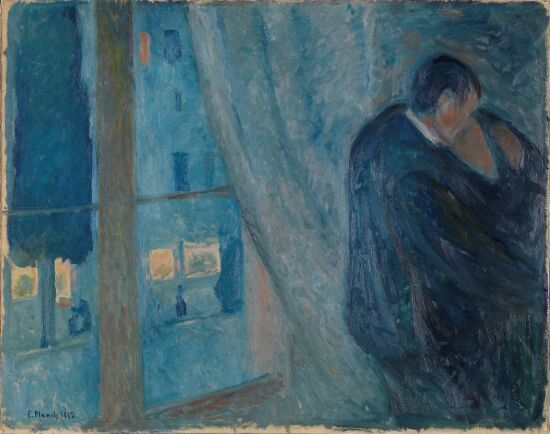 The KissEdvard Munch1892
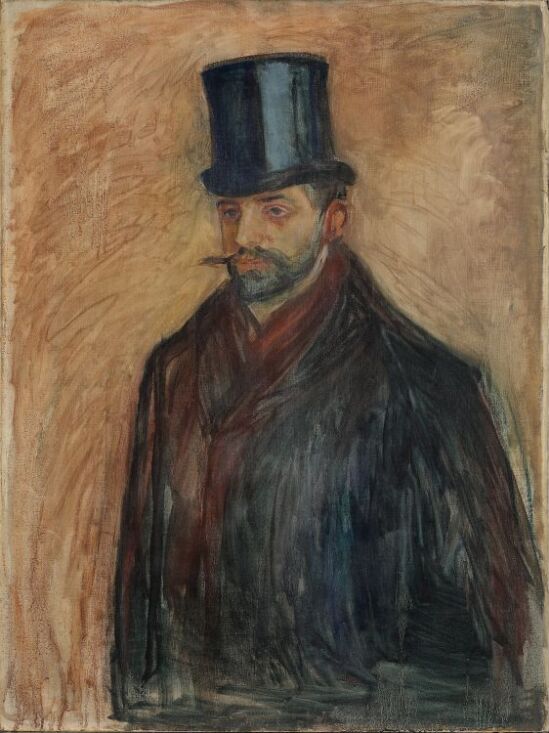 Julius Meier-GraefeEdvard MunchAntagelig 1894
 From Vestre AkerEdvard Munch1881
 Young Woman Washing herselfEdvard Munch(1896)
 MelancholyEdvard MunchAntagelig 1892
 Flowery Meadow at VeierlandEdvard Munch(1887)
 White NightEdvard MunchPåbegynt 1900, avsluttet 1901
 Rue LafayetteEdvard Munch1891
 Naked Woman in Front of a HouseEdvard Munch1883 eller 1884
 Self-PortraitEdvard Munch1905
 Hjørdis GierløffEdvard MunchPlaten utført 1913 eller 1914; trykket 1914
 NudeEdvard MunchPlaten utført 1897; trykket 1913