Oltre Terra. Why Wool Matters

In the exhibition “Oltre Terra. Why Wool Matters” the multidisciplinary design studio Formafantasma investigates the history, ecology and global dynamics of the extraction and production of wool.
In February 2021, the rescue of a runaway Merino sheep gained international fame when it was found in the outskirts of Victoria, Australia with 35 kilograms of wool on its back. This extraordinary occurrence was simply the result of a lack of contact: if Merinos are not sheared by humans, their fleece will continue to grow indefinitely.
As a vivid illustration of modernity’s bioprospecting paradigm, this sheep resembled a wool-producing machine with nose and ears, carefully designed for optimization and economic profit, rather than an animal.
Around 11,000 years ago, hunter-gatherers began to follow and cull flocks of sheep instead of killing them wholesale. With time, a new relation between human and animal was established and domestic sheep as we know them today evolved over the course of hundreds of years. This process, however, was never unidirectional – that is, humans acting upon animals. Rather, a complex co-evolution and co-creation has taken place.
The exhibition
“Oltre Terra. Why Wool Matters” brings together various items relating to sheep farming and the wool industry, paintings, textiles, photographs and videos. A 1,700-year-old tunic, goat masks, and a commissioned video work by artist Joanna Piotrowska, are just some of the objects on display. At the centre of the exhibition, visitors are invited to relax on a large carpet made of a type of wool that would normally be discarded by the wool industry. There is also plenty of research material that lets you delve deeper into the exhibition’s topics.
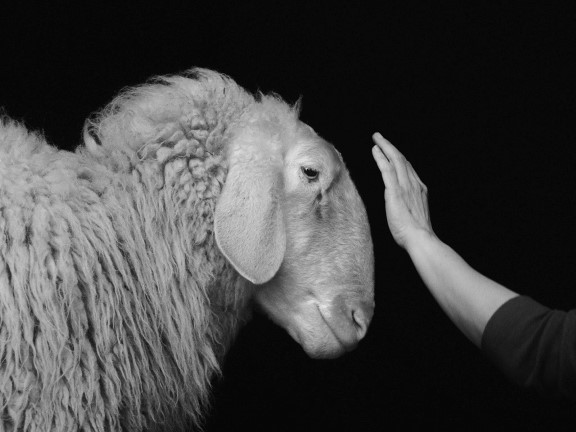
Transhumance
The title of the exhibition, Oltre Terra, is the Italian term for transhumance, the practice of moving livestock from one grazing ground to another depending on the season and the availability of fodder. The term transhumance itself comes from Latin (trans = across, “oltre” in Italian, and humus = grounds, “terra” in Italian). Transhuman practices involve the constant negotiation of factors relating to the environment, and the humans and animals who inhabit it.
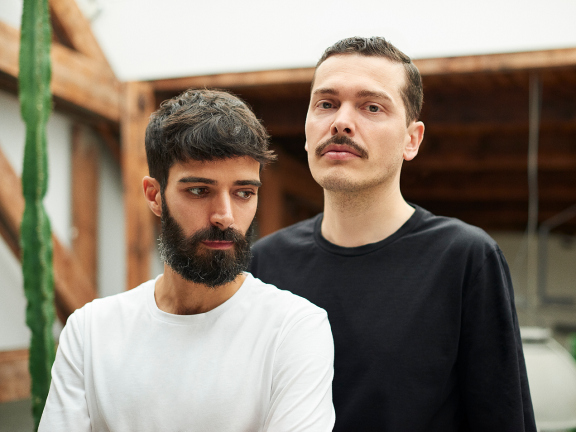
Formafantasma
Through numerous exhibitions, research projects and teaching activities, the Italian design studio Formafantasma (founded 2009) has advocated the need for a new direction and vision for the field of design at large, with the overall ambition of fostering a deeper understanding of both our natural and built environments. Their work typically consists of transformative interventions that use the very act of design in all its material, technical and social aspects.
Works by Formafantasma have been presented and acquired in the permanent collection of international museums such as New York’s MoMA and Metropolitan Museum, the Art Institute Chicago, London’s Victoria and Albert Museum and Serpentine Galleries, Paris’ Centre Pompidou, Amsterdam’s Stedelijk Museum, the National Gallery of Victoria in Melbourne, among others.
The exhibition "Oltre Terra. Why Wool Matters" is supported by:
Fondazione In Between Art Film
Explore the exhibition in 3D
Presseomtaler
– It is not necessarily and exhibition about wool, it's more about the interaction with living creatures and the ethical political implications of doing so.
–Pecore, uomini, lana ed ecologia: Formafantasma svela Oltre Terra, nuovo progetto di scena a Oslo
– En ullutstilling ber oss ta materialenes kultur- og naturhistorier med i beregningen
Den sveitsiske avisen Neue Zurcher Zeitung anbefaler utstillingen, 18.6.2023
– Nasjonalmuseet ga den italienske designduoen Formafantasma i oppdrag å forske på ull. Resultatet setter selve samlivet mellom mennesket og sau under lupen.
– Oltre Terra exhibition calls for "constructive relationship" between humans and sheep
– Norge fortjener en utstilling som viser mer både av vår fantastiske ulltradisjon og hvordan denne kan bidra positivt i bærekraftig utvikling.
– Oltre Terre is both educational and inspirational as an exhibition and research project. Pushing forward the idea of looking locally and rethinking our relationship to animals and natural materials and to consider how new industries and ideas can be generated from these fundamental resources feels so in tune with where we should be focusing our energy as a culture and within communities.Blaire Dessent, TL Magazine 9.6.2023
«Oltre Terre. Art & Nature»
– Det er tankevekkende perspektiver de bringer opp. En veldig viktig og spennende utstilling!
– Bringing worlds together: From chaos research to interconnected design.
Ruth Aitken, Kunsthåndverk, 7.6.2023
– Rather than viewing wool as simply a material, Oltre Terra–a play on the Italian and Latin roots for the seasonal pastoral grazing practice known as transhumance–examines the relationship between people, animals and the environment.
– Storia della lana e rapporto uomo-animali: Formafantasma a Oslo.
– Formafantasma’s Oltre Terra explores our relationship with tool.
– By combining materials, techniques, and living organisms, Oltre Terra challenges the current categorizations that artificially separate humans from animals and products from biological matter.
– I Formafantasma al Salone del Mobile 2023: il design sostenibile e la loro filosofia pratica.
– Il design salverà il pianeta.
Grazia Italia, 13.4.2023
– Formafantasma: Più che sul prodotto, ci stiamo concentrando sui processi.
– Italiensk blikk på ull.
Magasinet Norsk Husflid
– By looking at the development of wool production and material culture, the show aims to unravel the complexities interwoven within the symbiosis between animals, humans, and the environment.

