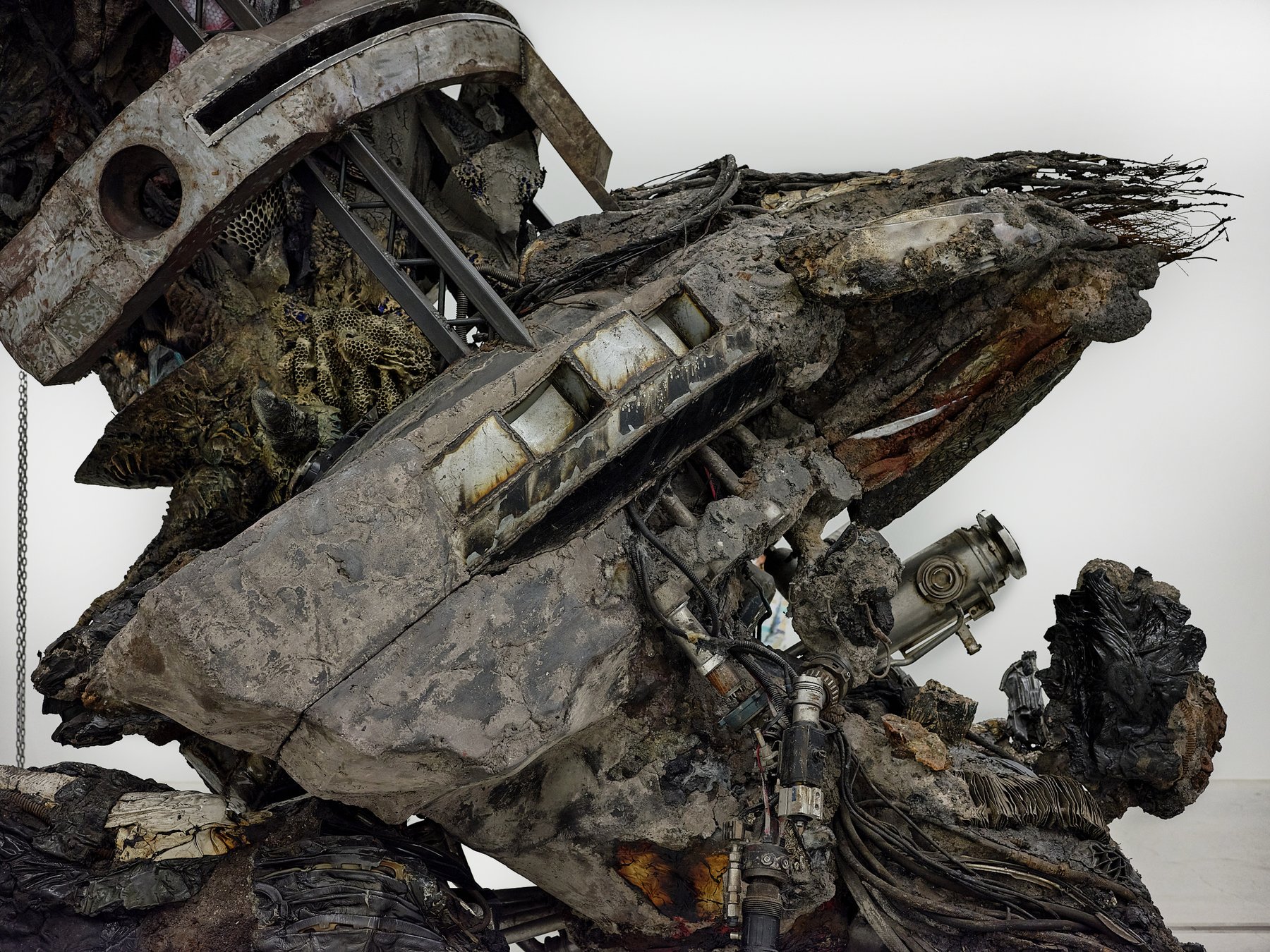
Over the last two decades, Villar Rojas’s installations have “landed” in Buenos Aires, Yangji-ri, Kalba, Athens, Seto, Shanghai, Seoul, Vallée de Joux, Aspen and elsewhere. Each time, the work absorbs the architecture, labour, geology, climate, institutional metabolism and political conditions of the site.
What appears is not an artwork but an ecology – a self-generating organism composed of soil, humidity, temperature shifts, digital simulations, insects, fungi, moss, discarded objects, human collaborators and time itself.
These installations do not travel; they propagate. They decay in situ, or only fragments survive, repurposed into later worlds. Their archive is scattered, discontinuous, fundamentally incomplete. The global body of the practice exists, but never as a panorama – only as distributed, unaligned realities improvising themselves at different speeds.
Adrián Villar Rojas’s practice can be understood as a constellation of John von Neumann’s worlds: self-propagating, self-modifying ecosystems that emerge, evolve and disappear across the planet.
Like the self-replicating probes theorised in astrobiology – machines that land in a new environment, absorb its materials and conditions, and generate a divergent offspring – each of Villar Rojas’s projects arrives, mutates and branches into a new reality.
None of these worlds can ever be seen together. No human can hold the total map.