301 The Light Hall
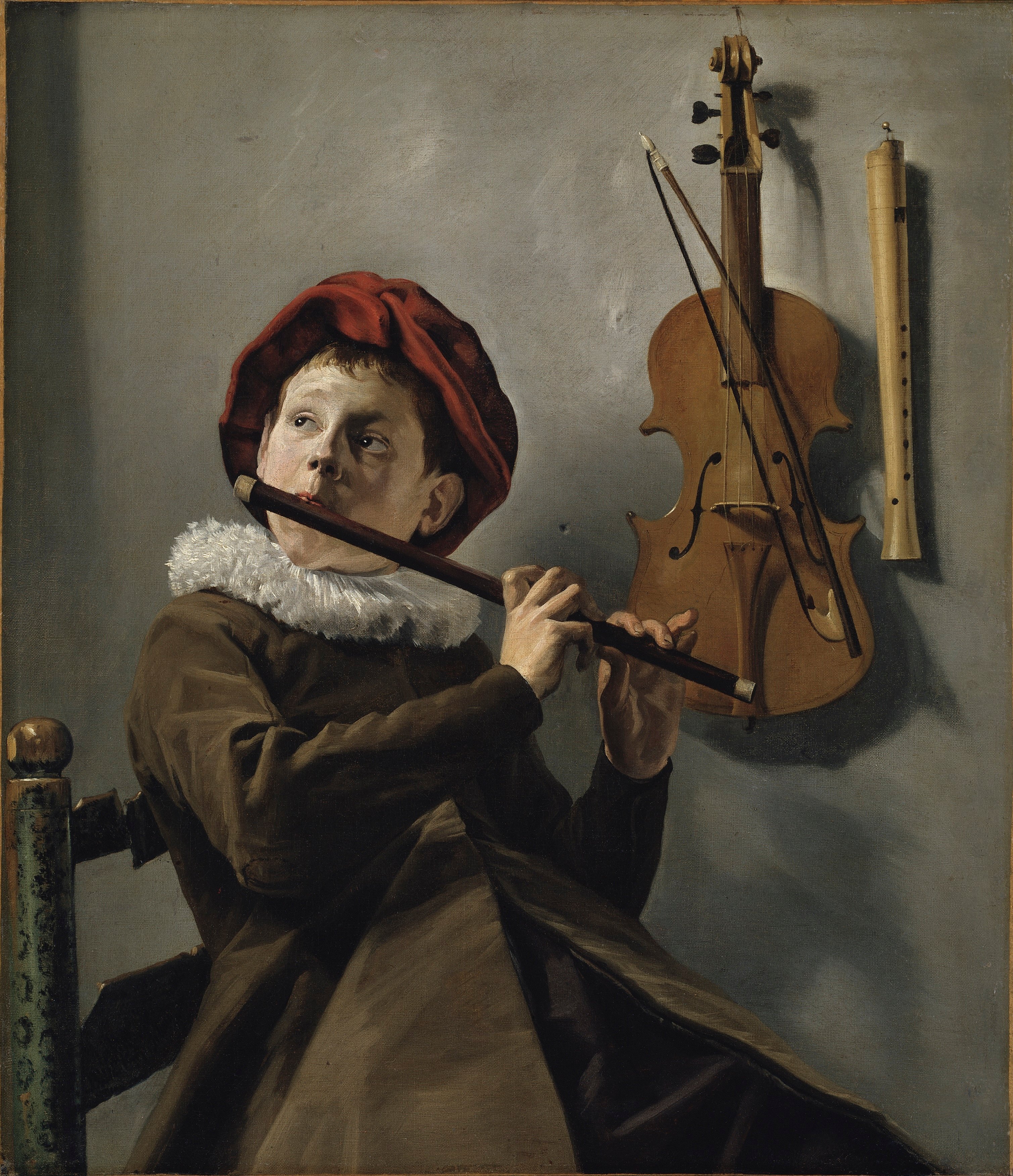
Boy Playing the Flute
Judith Leyster
Narrator
This is one of the most iconic paintings by the Dutch artist Judith Leyster.Although we can’t say for sure, she was probably the first woman to become a member of the painters’ guild in Haarlem, registering in 1633.
By the 1630s, she was even running her own workshop with several apprentices.
Her work often captures lively genre scenes – people celebrating, making music, or painting.
Here’s Cynthia Osiecki, art historian at the National Museum, to tell us more.Cynthia Osiecki
Here, we find ourselves in the midst of a musical mystery. We don’t actually know who the young flute player is, or even if he represents a real person.It’s possible that this is an allegory of music itself, or of the sense of hearing.
This was a popular genre at the time, and there’s many interpretations of this. What’s clear, though, is just how skilled and original Leyster was as an artist.
Narrator
Her style was so convincing that, for a long time, her works were mistaken for those of the famous painter Frans Hals.Cynthia Osiecki
It wasn’t until the 19th century that her identity was uncovered, and in 1893 this painting was finally attributed to her correctly.Her signature is quite distinctive, too; often made up of the letters “J” and “L,” followed by a line ending in a star. It’s actually a visual play on her surname: “Ley-ster,” or “lodestar” which in this painting, you can see on the mouthpiece of the flute on the wall.
Narrator
The scene feels immediate and alive, as if we’ve caught a moment in progress. At the same time, there’s small details that create a sense of tension.Cynthia Osiecki
Take the way the boy leans back against the chair, where the top rail is broken, and you almost feel like he might fall at any moment.It’s also particularly interesting how the flute, a wind instrument, is shown alongside string instruments. At the time, these were often seen as harmonious opposites.