310 The Light Hall
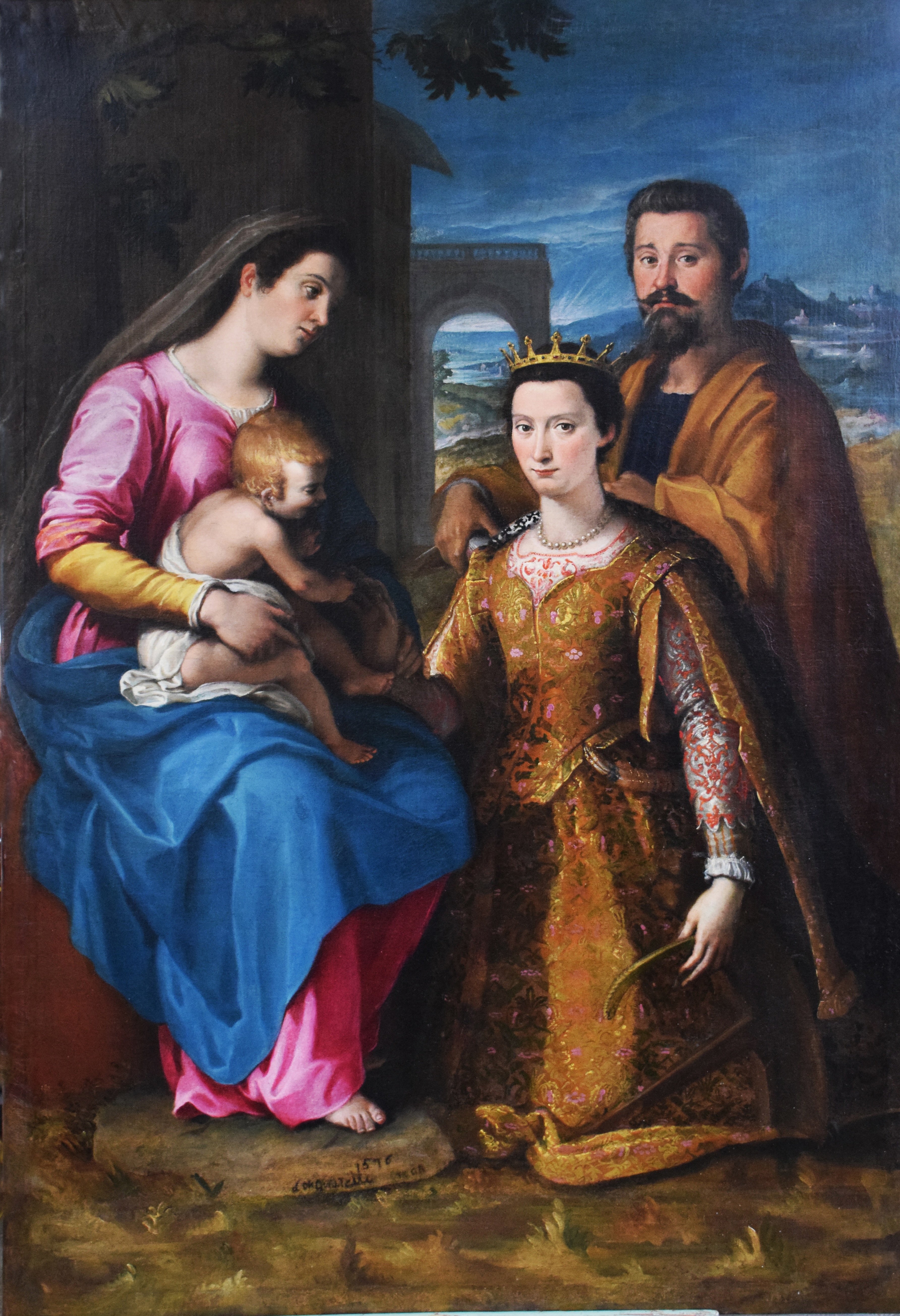
The Mystical Marriage of St. Catherine
Lucrezia Quistelli della Mirandola
Cynthia Osiecki
Lucrezia Quistelli della Mirandola is one of those artists whose life is reduced to just a few lines in art history. In fact, the great historian Giorgio Vasari mentions her only briefly in his 1568 collection of artist biographies, and that’s almost all we know about her today.Narrator
This is Cynthia Osiecki, art historian at the National Museum.Cynthia Osiecki
Alongside Sofonisba Anguissola and Plautilla Nelli – both represented in this exhibition – Quistelli represents a rare example of a woman artist who didn’t grow up in an artistic family. Instead, like Anguissola, she came from the social elite.Narrator
The painting comes from the church of Santa Maria e San Pietro in Silvano Pietra, southwest of Pavia, in Italy.The Virgin Mary sits with the Christ Child on her lap, her feet resting on a stone block. It’s on this block that Quistelli signs and dates the painting.
Cynthia Osiecki
This work is especially important because it’s one of very few paintings that can be securely attributed to her – possibly even the only one.In front of Mary, looking directly at us, is Saint Catherine of Alexandria, an Egyptian virgin martyr who, according to tradition, was executed in the early 4th century. Behind her is an unidentified apostle, painted with a remarkable degree of realism – especially considering the work dates from the 1570s.
In her left hand, Catherine holds the instrument of her martyrdom: a fragment of the spiked wheel on which she was executed. She wears an opulent dress that almost merges with the grass beneath her, and she wears a gold crown.
She’s part of what theology calls the “mystical marriage” between Catherine and Christ. We see how the Christ Child places a ring on her right hand – a symbol of the sacred connection between them and of Catherine’s spiritual union with Christ. This isn’t a marriage in the ordinary, earthly sense, but an image of complete religious devotion.
Narrator
This mystical marriage expresses Catherine’s absolute loyalty and dedication to the Christian faith – a devotion that, according to legend, ultimately cost her her life.At the same time, it’s what led to her being made the patron saint of students, philosophers, and scholars.