311 The Light Hall
Minerva in the Act of Dressing
Lavinia Fontana
Narrator
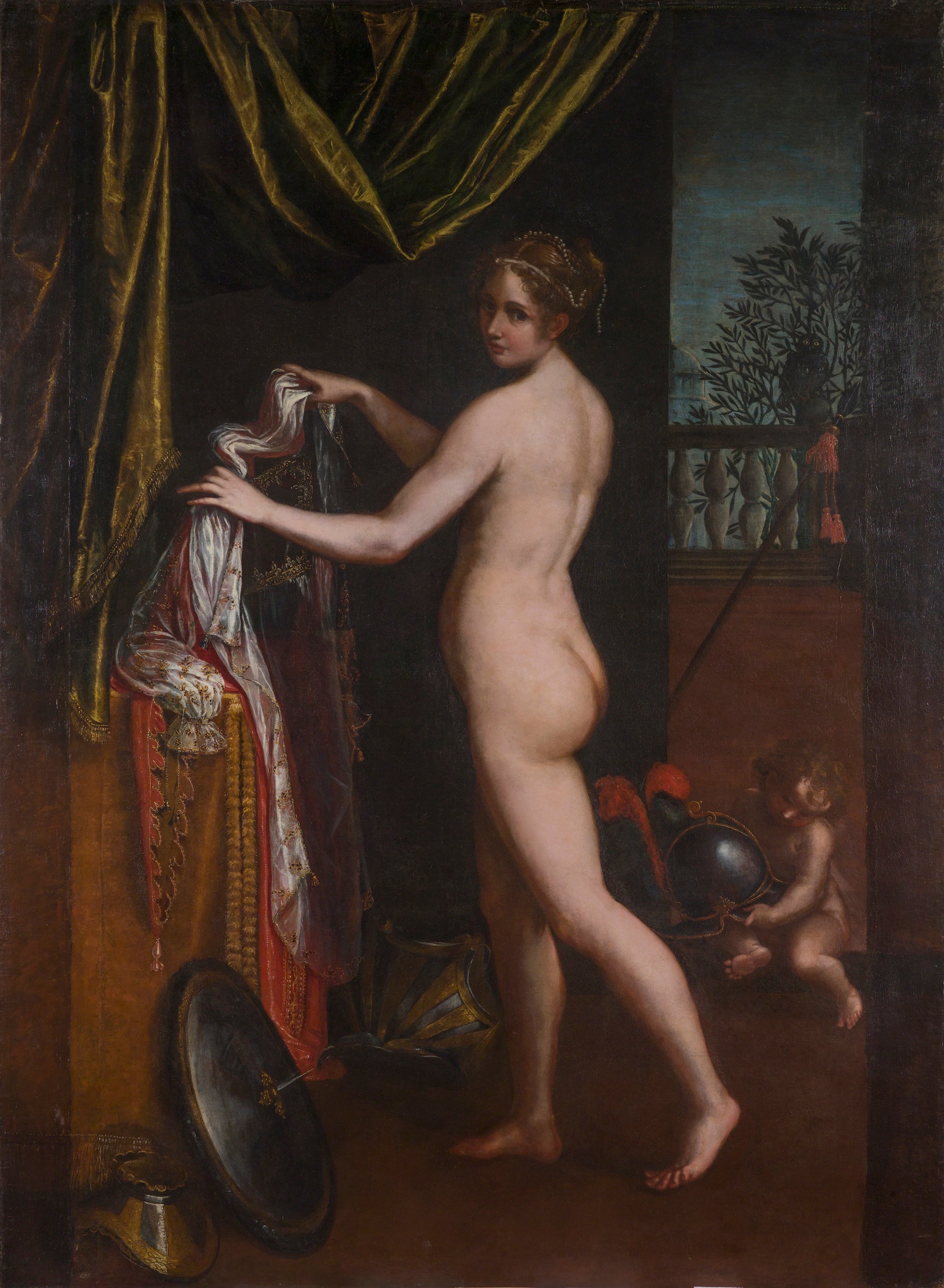
A young woman stands in the middle of dressing. She’s caught between moments – half undressed – but clearly aware she’s not alone. She turns her head, glancing over her left shoulder, meeting our gaze directly.This woman could have been taken from any aristocratic bedroom in contemporary Rome. In fact, Lavinia Fontana painted this in Rome, and it would become the last painting she completed before her death.
If you look closely in the background, you can even make out the edge of Michelangelo’s dome of St. Peter’s Basilica, just beyond the olive tree on the balcony.
Here’s Cynthia Osiecki, art historian at the National Museum, to tell us more.
Cynthia Osiecki
But this isn’t just an ordinary woman. What we’re actually looking at is Minerva – the Roman goddess of wisdom, known as Athena in Greek mythology.Here, she has set aside her weapons and is about to put on a long, elegant dress. Around her, you can see her attributes scattered – her shield, her breastplate, and other pieces of armor lie at her feet. A small cupid can be seen playing with her feathered helmet.
And if you look out onto the balcony to the right, you’ll spot three key symbols associated with her: the spear, the olive tree, and the owl, Athene noctua. The owl serves as a clear symbol of her role as the goddess of wisdom.
Lavinia Fontana herself was what was known then as a nobil donna – a woman from a high-ranking family with a strong education. She worked with virtuosity across all genres, and painted for churches, chapels, and private patrons.
Her series of mythological female nudes were particularly groundbreaking. They helped open the door for later artists, including Artemisia Gentileschi. In fact, this painting could be one of the first known example of a woman in the 16th century painting a nude female figure from a live model.
Narrator
Fontana trained with her father, Prospero Fontana, as well as the painter Ludovico Carracci. Over the course of her career, she worked for several popes and became first female member of Rome’s art academy, the Accademia di San Luca.This painting was commissioned by Cardinal Scipione Borghese – one of the great art collectors and patrons of pleasure in 17th-century Rome.
He was so admired, that in his own time, he earned the nickname La delizia di Roma - “the delight of Rome.”