About
- Edvard Munch bestandskatalog
In the spring of 1909, after an eight-month period of convalescence at Dr. Jacobson's clinic in Copenhagen, Munch returned to Norway. Over the following years, he moved between several homes -- at Kragerø, Hvitsten, Jeløy -- all of them in rural surroundings. Landscapes and farms with labourers and animals established themselves as a new theme in his paintings. In 1916, he bought Ekely, a property on the outskirts of Kristiania with a vegetable garden, orchard and fields. It was here he would live and work for the rest of his life. Munch was fond of animals and eventually kept chickens, cows, pigs, horses, and dogs at Ekely. Horses became particularly important as subject matter. Autumn Ploughing is one of the more imposing works in this thematic group and, like the better known Man in the Cabbage Field (Nasjonalmuseet, NG.M.01865), effuses qualities of vitality and physical strength. Common to both pictures is the combination of a spontaneous moment with a monumentally conceived composition. The difference in size between the horses and the farmer following the plough creates an impression of significant depth. Broad curving brushstrokes converge on a point somewhere behind the horses and the farmer. The landscape is built up from clear, distinct colour fields, forming an overall scene that is notable for its rich and varied palette. At a time when many of Munch's continental artist colleagues were interested in representing the dynamism of modern life, the industry of the machine age, and the bustle of the metropolis, Munch chose to concentrate on the forces of nature. Here it is the sturdy strength and energy of the horses that dominates. But far from being a nostalgic depiction of some rural idyll, Autumn Ploughing has all the markings of a directly observed scene from everyday life.
It is said that Munch loved his horses, and that some of his last articulated thoughts were concerned with the care of his horse Rousseau, who had been his model for many years (Stang 1977). Horses were working animals not just for the farmer, but also for the artist. Among the notes in Munch's literary estate, we find a draft letter addressed to the Norwegian tax authorities, in which he argues for tax deductions to compensate his expenses in maintaining a horse as a model:
Expenses for my white horse [...] 600 kr. This horse I keep exclusively for use as a model since it can be used for little else. It is very important for my painting, and pictures of it can be found in large collections such as e.g. the Münchener Statsgalleri, and it has brought in a lot of money to the tax authority and will continue to do so -- (undated note, emunch.no: MM N 3597)
The painting was gifted to the museum by Charlotte and Christian Mustad in 1937. For many years it was known by the title Hestespann (Horse Team), but this has since been revised to Autumn Ploughing (Woll 2008), which was also the title it had when first exhibited at Blomqvist in 1919. Produced at Ekely, there exist three closely related paintings from the same year (Woll M 1342; Woll M 1343; Woll M 1344).
Vibeke Waallann Hansen The text was first published in Edvard Munch in the National Museum. A comprehensive overview (Oslo: National Museum, 2022).
- Creation date:
- 1919
- Other titles:
- Høstpløying (NOR)
- Object type:
- Painting
- Technique and material:
- Olje på lerret
- Material:
- Canvas
- Dimensions:
- Width: 145.5 cm
- Height: 110.5 cm
- Keywords:
- Visual art
- Classification:
- 532 - Bildende kunst
- Motif:
- Animal
- Inventory no.:
- NG.M.01863
- Cataloguing level:
- Single object
- Inscriptions:
- Primary, Inscription, nede høyre: E. Munch 1919
- Acquisition:
- Gift from Charlotte and Christian Mustad 1937
- Provenance:
- [40] Previous owner, Christian Nicolai Mustad
[40] Previous owner, Charlotte Mustad - Owner and collection:
- Nasjonalmuseet for kunst, arkitektur og design, The Fine Art Collections
- Photo:
- Børre Høstland
- Hansen, Vibeke Waallann, et al. Edvard Munch i Nasjonalmuseet: en samlet oversikt. Redigert av Ustvedt, Øystein, et al. Oslo: Nasjonalmuseet, 2022. kat.nr. 56.
- Woll, Gerd. Edvard Munch: samlede malerier: B. 3: 1909-1920. Oslo: Cappelen Damm, 2008. kat.nr. 1341.
- Nasjonalgalleriet, red. Norske malerier. Katalog. Oslo, 1992. 346.
- Stang, Ragna. Edvard Munch: mennesket og kunstneren. Oslo: Aschehoug, 1977. 259–60.
- Nasjonalgalleriet, red. Katalog over norsk malerkunst: med 158 illustrasjoner. Oslo, 1968. kat.nr. 1305.
- Nasjonalgalleriet, red. Katalog over norsk malerkunst. Oslo, 1950. kat.nr. 1086.
Nasjonalmuseet's collection catalogue is a living resource of information gathered since the 1830's. Some records may contain language or ideas that today could be perceived as outdated, offensive or discriminatory with regard to for instance gender, sexuality, ethnicity or disability, and that may be at odds with the museum's values regarding equality and diversity.
Do you have suggestions for how this record can be improved? We would like to hear from you!
If you would like more information about specific objects in the collection or about objects that haven't been published online, please contact the museum. You can read more about how we work with the collection and our cataloguing practice here.
Other works by Edvard Munch
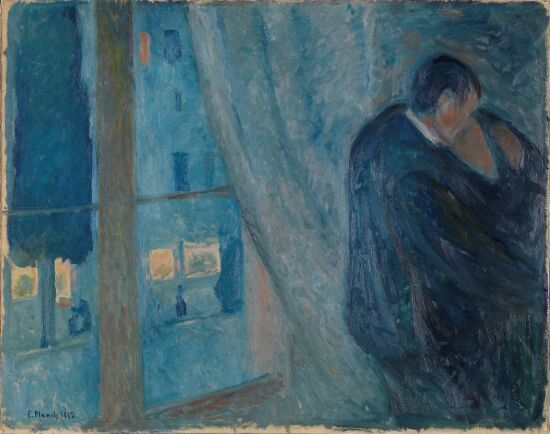 The KissEdvard Munch1892
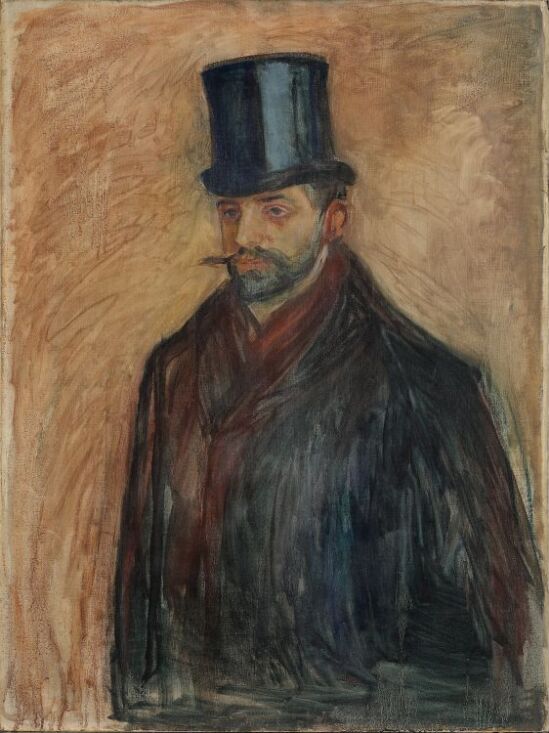 Julius Meier-GraefeEdvard MunchAntagelig 1894
 From Vestre AkerEdvard Munch1881
 MelancholyEdvard MunchAntagelig 1892
 Flowery Meadow at VeierlandEdvard Munch(1887)
 White NightEdvard MunchPåbegynt 1900, avsluttet 1901
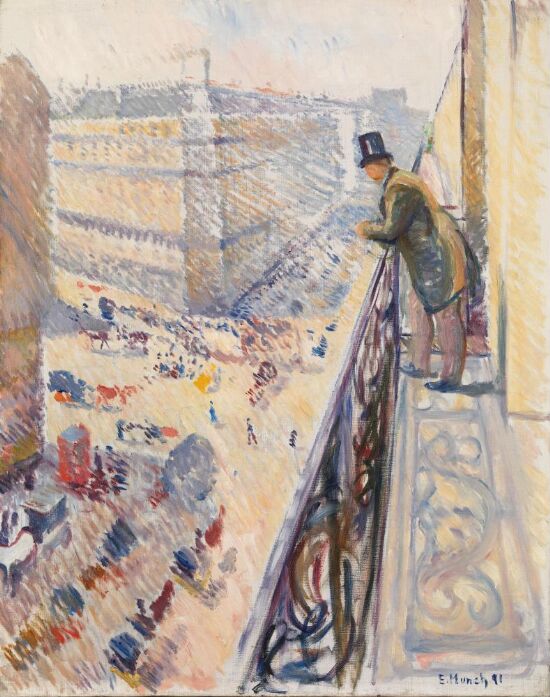 Rue LafayetteEdvard Munch1891
 Naked Woman in Front of a HouseEdvard Munch1883 eller 1884
 Self-PortraitEdvard Munch1905
 Inger Munch in BlackEdvard Munch1884
 Bathing ManEdvard Munch(1918)
 NudeEdvard MunchPlaten utført 1897; trykket 1913